Showing posts with label awareness-raising. Show all posts

Tuesday, 1 January 2013

ORCID en los países de habla hispana


  Se leía el otro dia en un tweet que ORCID como iniciativa de identificacion de autores beneficiaría sobre todo a las mujeres, en una referencia a la acendrada costumbre en muchos países de que las mujeres cambien de apellido con el matrimonio.

Dado que esta costumbre no está tan arraigada en el mundo hispanohablante, será tal vez por ello que, con la excepción de España, no se encuentra ningún otro país hispanohablante en la lista de los 25 en los que ORCID está arraigando con más fuerza. Teniendo en cuenta que el registro en ORCID es gratuito para los autores y considerando asimismo el elevado número de excelentes comunicadores en el ámbito de la gestión de información científica que pueblan la lista LLAAR sobre Acceso Abierto y Repositorios, esto no deja no obstante de constituir una considerable sorpresa.

En el día en que tradicionalmente se formulan los propósitos de año nuevo, hacer un esfuerzo por incorporar a los países hispanohablantes a próximas ediciones de este listado internacional podría ser una sugerencia interesante...


Por supuesto, la auténtica razón para la ausencia de los países hispanohablantes de este listado no es la que se apunta más arriba, sino la que se deduce de este otro tweet de fecha 28 de diciembre:

"ORCID now has 42,918 researchers registered, a third via manuscript systems or linking with other IDs"


Monday, 24 December 2012

2012: el año de ORCID

0000-0001-6300-1033, ORCID Outreach WG member


  Estas fechas en las que tradicionalmente se echa la vista atrás para recordar los principales acontecimientos del año son también un buen momento para recapitular novedades y examinar tendencias de futuro en el ámbito de la comunicación científica. En este sentido es fácil aventurar que dentro de diez años 2012 será recordado -entre otras cosas- como el año en que entró en servicio la iniciativa Open Researcher and Contributor ID, el identificador ORCID que finalmente facilitaría la solución a los hasta entonces perpetuos problemas de asignación de las publicaciones científicas a sus autores y de desambiguación de los nombres de éstos.

ORCID se lanzó como servicio a mediados de octubre de 2012, después de un sostenido sprint final por parte del reducido equipo de profesionales que está sacando adelante esta iniciativa sin ánimo de lucro. Poco más de dos meses después de su puesta en servicio, más de 30,000 autores del mundo entero han registrado ya de manera gratuita su identificador desde el formulario de registro en el sitio web de ORCID.

Al mismo tiempo que progresa la adopción individual del estándar a través del boca a boca -con las redes sociales y twitter en particular como un poderoso instrumento de difusión- ORCID continúa la consolidación de su plataforma y de los servicios de integración con editores y bases de datos que desde ella se ofrecen (ver figura más abajo). Para garantizar la sostenibilidad de estos desarrollos y de la iniciativa en su conjunto será precisa la generalización de un modelo colaborativo de suscripción institucional que haga recaer la responsabilidad de la sostenibilidad del servicio en las organizaciones que se benefician del mismo, sean universidades, centros de investigación o editores. Este modelo de implicación institucional colectiva en la provisión de un servicio no es ajeno al mundo de la comunicación científica, donde ejemplos como el nuevo modelo de financiación del repositorio arXiv en la Universidad de Cornell o la iniciativa SCOAP3 del CERN para ofrecer acceso abierto a todo un conjunto de revistas científicas en el campo de la física de altas energías demuestran que es una alternativa viable e incluso preferible a modelos de financiación más restringidos por organizaciones o países.


A medida que avanza el desarrollo de nuevos servicios de integración -que irán consolidando a lo largo del próximo año- el gran reto para el éxito de ORCID reside cada vez más en la comunicación del avance en su implantación, de sus ventajas y de sus procesos de trabajo. En un momento en que comienzan a producirse registros institucionales para la adopción temprana del nuevo estándar de identificación, será fundamental dar a conocer los procedimientos y las estrategias de implantación seguidas por las primeras instituciones en integrar ORCID en sus sistemas de gestión de la información científica, de manera que sean reutilizables por las instituciones que se incorporen a la iniciativa de manera más tardía.

El papel de los servicios institucionales de información (bibliotecas o centros de documentación) resultará también crítico para el éxito de ORCID: será tarea suya poner a disposición de los autores la información necesaria para que ellos puedan registrarse gratuitamente y pasar a formar parte de una iniciativa que cobrará cada vez más fuerza con su adopción por parte de editores, agencias de finaciación y bases de datos internacionales.

Cabe destacar como un ejemplo de buenas prácticas en este sentido la iniciativa de Consol García, 0000-0001-8085-0088, y de sus compañeras de la Universitat Politècnica de Catalunya (UPC), para crear una página web dedicada a ORCID -inicialmente en catalán, ahora también en castellano- como parte del sitio web de Bibliotècnica, la Biblioteca Digital UPC. La UPC no se ha registrado por el momento como miembro de ORCID, pero esto no es óbice para que desde su Servicio de Biblioteca se haya percibido como una línea importante de trabajo la comunicación de información sobre el identificador universal de autor para los académicos e investigadores de la institución. Una adecuada difusión de la existencia de esta página a través de los canales de comunicación institucionales y la extensión de este tipo de iniciativa a otras universidades suponen un impulso decisivo para la consolidación de un estándar que goza por lo demás (ver mapa en la figura inferior) de muy buena salud en España a pesar de la delicada situación económica de muchas de sus instituciones de educación superior.


Tuesday, 18 September 2012

Discussing ORCID... and the Gold vs Green controversy


  A new GrandIR technical session was held on Sep 6th at the Open University of Catalonia (Universitat Oberta de Catalunya, UOC) in Barcelona. This new workshop was devoted to Author IDs and ORCID (Open Researcher and Contributor ID) and brought together representatives from the various stakeholders concerned by the launch of the ORCID service, to take place next Oct 15th. The event programme included ORCID themselves (Martin Fenner, Chair of the ORCID Outreach Working Group), National author ID initiatives (Amanda Hill, Names Project UK), funders (Gerry Lawson, Natural Environment Research Council, NERC), National Research Offices (David Arellano, Spanish Foundation for Science and Technology, FECYT) and publishers/vendors (Philip Purnell, Thomson Reuters). Each of the speakers delivered a presentation (files are downloadable from the session programme) and a round table was held afterwards in order to discuss the requirements for an universal author identifier as well as its implications and challenges.

A summary of the session discussions follows:
    • - ORCID service is set to be launched Oct 15th. Martin Fenner provided an up-to-date view of the ORCID interface as it stands right now, although -he mentioned- it keeps evolving every day.
      - ORCID business model is currently being established along the following lines: the service will be free for individual authors/researchers, and there will be a fee for institutions, to be classified as small or large. Charge for small ones will be $4,000 per year. Overlay services will gradually be made available.
      - ORCID will run different strategies for buiding up an author database: (free) individual registration for authors, collective registration for institutions (for a fee), collection & upgrade from other existing author IDs - such as ThomsonReuters ResearcherID, Scopus Author Identifier, arXiv, etc.
      - ORCID duplication may result from overlapping registration strategies - some dissambiguation work should be required to clear those. ORCID won't be providing this service (at least not at launchtime, although possibly later on), so this might be a potential role for National Author ID projects (such as Names, DAI or Lattes) which lie closer to the authors.
      - Two main workflows have been designed so far for promoting ORCID use: (i) Publisher Workflow, meaning publishers will request ORCIDs to authors at manuscript submission time, and (ii) Funder Workflow, by which funders will request ORCIDs to researchers at grant bid submission time. Several publishers are already working to enable ORCID collection, and research funders are happy to be able to work with a non-profit initiative instead of commercial providers.
    • - Institutions running a CRIS system will be better positioned for ORCID implementation, once the required datamodel updates are performed (euroCRIS CERIF TG is currently working on CERIF datamodel enhancement in order to bring persistent identifiers into the system). For those HEIs not running CRIS Systems (for which CERIF is incidentally not a requirement), Institutional Repositories may as well play a key role for ORCID implementation purposes.
      - There are a number of author ID-related services that ORCID will not aim to provide. Among these, organisation IDs, citations, usage or other value-added services. ORCID actually aims to provide a basic feature (namely author identifier plus attached publications) on top of which other stakeholders are expected to build value-added services. ThomsonReuters ResearcherID (as well as other commercial or national author ID services) is therefore not planned to be superseded by ORCID, but they will co-exist instead.
      - One month away from service launch, there are several important factors that remain unclear, such as the service takeup by authors, the project timeschedule or the level of duplication that may result from overlapping registration strategies. Strategies for service dissemination among the research community remain also to be defined to some extent. However, meetings like the one held in Barcelona or the upcoming one at Humboldt-Universität in Berlin will certainly support awareness-raising among the research community.

  • Finally, the meeting in Barcelona also offered the opportunity to discuss with Gerry Lawson, UK Natural Environment Research Council (NERC), whether the RCUK policy for promoting Gold OA as a default option for complying with their Open Access policy turned the Research Council into "traitors" to the Open Access movement. When offered the opportunity to discuss their view, he said the Coucils were by no means opposed to Green OA - only after ten years work, repositories were still not complying the funders' requirements for tracking Open Access outputs and payments.

    Discussions on the default Gold OA direction the UK has taken following the release of the Finch Report should also account for this current reporting shortcomings in Green OA infrastructures. At the same time, requests for turning the RCUK OA Policy a more balanced supporting tool for both Gold and Green OA seem indeed reasonable enough.

    In summary, the session was very useful for disseminating the current state of the ORCID initiative on the verge of its being released and for discussing its implications and challenges for organisations and initiatives potentially involved in its roll out as a service to researchers and the wider community. Some additional session outcomes are starting to surface as requests for further ORCID dissemination at given universities in Spain - more information on this will be provided in due time. The ORCID Service launch meeting in Berlin next October will also provide new insights on the service that will be dutily reported.

    Video recordings of the interventions will shortly be made available at the UOC O2 Institutional Repository. A useful session summary in Spanish has also been published by Elvira Santamaria at the EPI Blog.

    Thursday, 13 September 2012

    Steady progress of Open Access at Kenyatta University and beyond


      As shown in the Open Access trend worldmap in the previous post, Kenya may well be the country where a strongest impulse towards Open Access implementation in a coordinated, cross-institutional way is currently under way. A high number of Kenyan universities are taking steps to issue Open Access policies and to set up their institutional repositories. These include Maseno University, which has recently become the first signatory of the Berlin Declaration on Open Access in Kenya, Kenyatta University, which is about to adopt an institutional Open Access policy and is already running its own IR, Moi University, University of Nairobi and JKUAT, which has recently issued a Digital Repository Policy document so well drafted that it may become a source of inspiration for many other institutions in the continent.

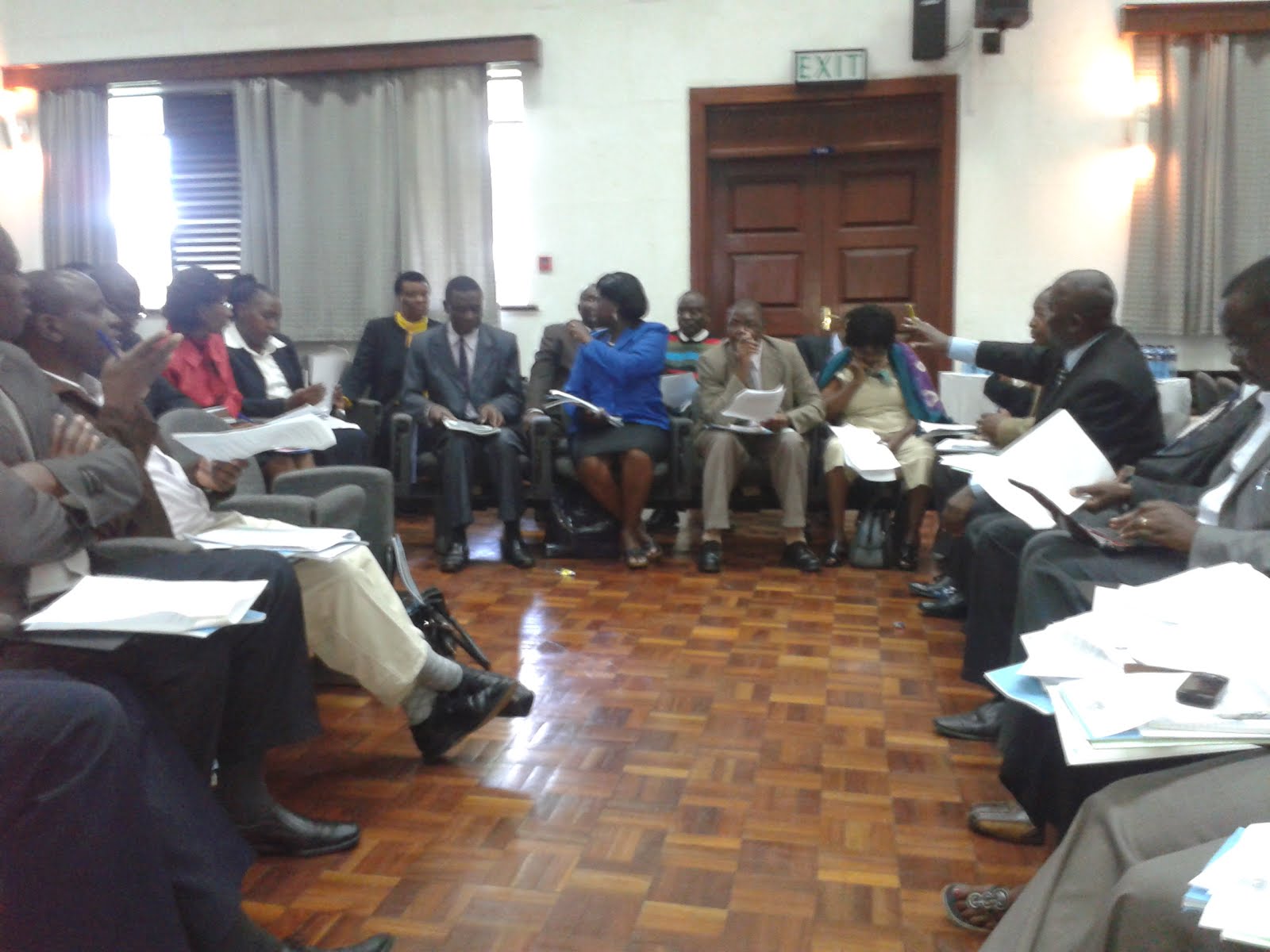
    Efforts during the Open Access activity week at KU were aimed to train the Kenyatta University IR and ICT staff and KU researchers and Management Board on Open Access and on how to deal with the new institutional repository which is being developed by the University Library. The 2-day seminar held at the Kenya School of Monetary Studies (KSMS) -organised by Reuben Njuguna, KU Dept. of Business Administration- provided the summit in the OA advocacy sessions held during the week. The first day of this event was devoted to introducing Open Access and its current worklines to the KU Management board, with talks by Gitau George Njoroge, Director of KU Library, Iryna Kuchma, EIFL Open Access Programme manager, William Nixon, Digital Library manager at the University of Glasgow and Brian Hole, manager of the Ubiquity Press Open Access publisher. The second day a round of group discussions was held among the KU VCs and professors in order to establish the guidelines for a draft Open Access policy for KU, which is now under review by the KU Law Department in order to make it final.


    In the meantime KU legacy dissertations are starting to be digitised in order to provide full-text files to the metadata-only items that presently constitute the largest part of the KU IR. Metadata sets associated with different document types are also undergoing an update so they'll fit the requirements for providing a thorough description of the KU research output. Once this processes reach an advanced state, an advocacy campaign for further dissemination of the advantages the IR provides the KU community will be carried out at KU Schools. Ideally this should result in KU researchers and professors having the opportunity to offer their online research profiles and publications in the same way as Dr. Erik Nordman, a GVSU researcher in environmental economics who is currently spending a sabbatical year at KU School of Environmental Studies and whose publications are easy to track at his home ScholarWorks@GVSU repository.

    The setting up of the KU IR will not only provide visibility for the KU scholarly output, but will also help introducing better description procedures for the Faculty members' publications. Once it gets consolidated as a fully operational reporting tool, the IR will also become the default platform for collecting the KU research output, including the journals internally published by KU Schools and Departments which are currently impossible to track online. If the IR Project at KU is able to keep its cruise speed and meet its strategic goals, the Kenyatta University Library should in the mid-term develop a research information management system as inspirating as its actual building.


    With the ongoing EIFL-funded Project “Knowledge without boundaries: Advocacy campaign in Kenya for OA and institutional repositories” providing a solid platform for promoting Open Access and IRs in the country through the Kenyan Library and Information Services Consortium (KLISC), a national network of well-populated institutional repositories could soon become a reality, showing the way ahead to other East African countries.

    Friday, 30 March 2012

    Raising visibility of repository contents for internet users


      Nowadays it has become commonplace to criticize institutional repositories for their lack of content specificity: you can't tell what version of the document is being made available, there is a lot of materials of insufficient quality in there, everything's mixed up, etc. When one has devoted a good part of one's professional career to develop such useful resources, this criticism is a bit painful to take. It's true IRs have weaknesses, even lots of weaknesses, but there is quite a number of people across the world working to solve them and to improve IR content quality and description. And IRs do have a decent collection of advantages alright - that should also be acknowledged to be fair. I shall now highlight one of those advantages, incidentally not even the most important one.

    This morning I was looking for some bibliography on research data management performed via institutional repositories for a report I'm currently working at. So I googled research data management institutional repositories and this is what I got:


    The reference that caught my attention was of course the one with the red square around it: seems to be called Institutional Repositories and Research Data and seems to be coming from Purdue University Library in the US, although the exact source is difficult to tell from the URL there: docs.lib.purdue.edu/cgi/viewcontent.cgi?...research.

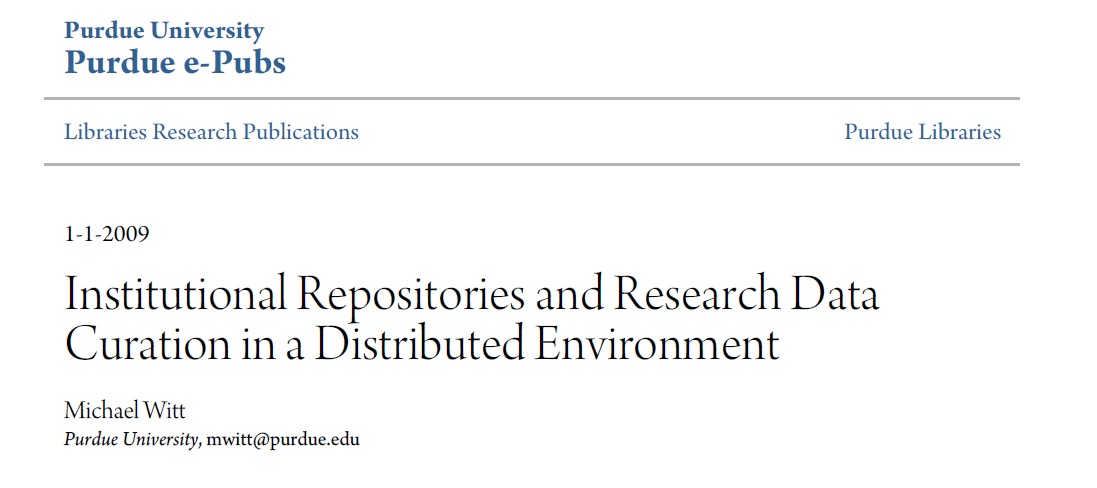
    When I opened it I was simply delighted to find this "Institutional Repositories and Research Data Curation in a Distributed Environment" report by Michael Witt and I was also quite amazed to see its publication date - there are clearly several speeds out there in research data management implementation.


    When trying to figure out how to cite this report I suddenly became aware of the document head: Purdue University, Purdue ePubs, Libraries research Publications, Purdue Libraries. Had this document by any chance been retrieved from an Institutional Repository? So I checked the footnote: "This document has been made available through Purdue e-Pubs, a service of the Purdue University Libraries. Please contact epubs@purdue.edu for additional information". I was simply ecstatic.


    I remember having had this discussion about inserting document covers into repository contents more than once when I worked as IR manager. The arguments for not doing it were always the same: we do have too many documents in the repository by now to start re-processing them all and we should instead focus on getting even more of them filed into the IR. These are quite good arguments indeed, but it's the kind of argument that lead to the issues we're now bitterly complaining about. It's a fact that IRs can be properly managed, that a great improvement in description standards has taken place and that there is a still a long way to go until we reach a consensus on a description standard that can please researchers. But not too many IRs that I know of have implemented this rather simple strategy of providing their documents a cover so that users will be able to identify their source and subsequently give it some credit. Of course there are lots of exceptions to this -if you're in the UK or the US you will say that's something every average repository has already cared for, see for instance this example from Enlighten repository in Glasgow or this other one from the LSE repo in London- but I'd say most IRs, even top-ranked ones, lack this small but very useful feature - since given the joint Open Access repository content figures nowadays, the repository+google/googlescholar combination is pretty much unbeatable. I would even dare to suggest some kind of harmonised international seal for identifying reliable research content coming from an institutional repository from their very cover - so that the user will be able to give credit where credit is due.

    Let me finish this piece of advocacy with a recommendation to read the abovementioned Purdue University Library report to any colleague interested in potential opportunities for starting out research data management initiatives from the University Library.

    Thursday, 15 March 2012

    Sobre PEER y awareness-raising


      Publica Ángel Borrego (Departamento de Biblioteconomía y Documentación de la Universitat de Barcelona) en el Blok de BiD un extenso e interesante comentario sobre el informe final "PEER Behavioural Research: Authors and Users vis-à-vis Journals and Repositories". Siguen a continuación algunas consideraciones adicionales al respecto, quizá un tanto extensas para incluirlas como comentario al post:

    Además de etiquetar las versiones de los trabajos especificando claramente si se trata de la versión publicada o de alguna clase de versión intermedia -algo que se está haciendo cada vez más sistemáticamente- los repositorios institucionales harían bien en distinguir con claridad su sección científica de la de 'otros materiales académicos' (incluyendo por ejemplo fondos patrimoniales). Esto es algo sobre lo que primero DRIVER y más adelante OpenAIRE han hecho notable hincapié, tratando de identificar repositorios con infraestructura científica para el Espacio Europeo de Investigación. La perspectiva desde las bibliotecas universitarias no suele ser sin embargo tan unánime al respecto, y sería quizá ahí donde habría que comenzar una labor de difusión eficaz de lo que son y pretenden los repositorios institucionales.

    Por otro lado, en relación con los conocimientos sobre acceso abierto y repositorios de los autores/investigadores, así como sobre su valoración de los mismos como herramientas de difusión de su producción científica, queda claramente mucho camino aún por andar. No obstante, muchos repositorios han alcanzado ya el suficiente grado de consolidación como para poder presentarse como una sólida infraestructura científica institucional en los congresos científicos, facilitando así su conocimiento por parte de los investigadores (véase por ejemplo este 'Computer applications and quantitative methods in Archaeology 2012' que se celebrará próximamente en Southampton con un notable énfasis en aspectos relacionados con el acceso a las publicaciones, sobre todo en el ámbito de datos de investigación).


    Finalmente comentar que además de estos aspectos relacionados con el awareness-rising, el proyecto PEER tiene interesantísimas cuestiones que debatir respecto a la interoperabilidad de repositorios y las oportunidades y los retos técnicos que plantea la transferencia de contenido entre plataformas (en el caso de PEER desde plataformas de editores hacia repositorios). Con COAR y el Grupo SONEX trabajando ya sobre estas cuestiones de interoperabilidad, la Conferencia fin de proyecto de PEER del próximo 29 de mayo en Bruselas puede ser una excelente oportunidad para una nueva entrada sobre PEER, sea en el propio Blok o en algún otro foro.

    Wednesday, 14 March 2012

    Por qué un Blog de GrandIR


      La comunidad de repositorios de acceso abierto cuenta ya con numerosos medios de transmisión de información relacionada con la disciplina: desde listas de distribución como OS Repositorios y LLAAR hasta blogs específicamente dedicados como el Blog del repositorio RUA de la Universidad de Alicante o el Blok de BiD de la Universitat de Barcelona, pasando por un elevado número de newsletters, tales como el de SPARC o el de Peter Suber. La cantidad de recursos de información es de hecho tan numerosa que se hace difícil en ocasiones encontrar tiempo para estar al día de todas las novedades.

    Y sin embargo, hay muchas actividades y convocatorias que permanecen sin cubrir a nivel de comentario o reflexión en el panorama del acceso abierto por falta de ventanas y de rapporteurs. Hay muchos proyectos apasionantes de los que casi nadie ha oído hablar en el ámbito porque se están desarrollando en comunidades concomitantes con la del acceso abierto pero faltan los puentes que las comuniquen. Muchos debates enriquecedores que se quedan sin desarrollar, a menudo por falta de tiempo, pero también porque los medios disponibles no son los más apropiados.

    Este Blog de GrandIR nace así con la pretensión de contribuir a difundir reflexiones e iniciativas que puedan favorecer el debate en el seno de la comunidad. Como tal Blog de GrandIR, los contenidos serán mayoritariamente aportados -en cualquier idioma, preferentemente en inglés o castellano- por los integrantes de la spin-off GrandIR, pero el blog estará abierto a comentarios y eventualmente a posts invitados de otros miembros de la comunidad de acceso abierto.