Showing posts with label developing countries. Show all posts

Thursday, 13 September 2012

Steady progress of Open Access at Kenyatta University and beyond


  As shown in the Open Access trend worldmap in the previous post, Kenya may well be the country where a strongest impulse towards Open Access implementation in a coordinated, cross-institutional way is currently under way. A high number of Kenyan universities are taking steps to issue Open Access policies and to set up their institutional repositories. These include Maseno University, which has recently become the first signatory of the Berlin Declaration on Open Access in Kenya, Kenyatta University, which is about to adopt an institutional Open Access policy and is already running its own IR, Moi University, University of Nairobi and JKUAT, which has recently issued a Digital Repository Policy document so well drafted that it may become a source of inspiration for many other institutions in the continent.

Efforts during the Open Access activity week at KU were aimed to train the Kenyatta University IR and ICT staff and KU researchers and Management Board on Open Access and on how to deal with the new institutional repository which is being developed by the University Library. The 2-day seminar held at the Kenya School of Monetary Studies (KSMS) -organised by Reuben Njuguna, KU Dept. of Business Administration- provided the summit in the OA advocacy sessions held during the week. The first day of this event was devoted to introducing Open Access and its current worklines to the KU Management board, with talks by Gitau George Njoroge, Director of KU Library, Iryna Kuchma, EIFL Open Access Programme manager, William Nixon, Digital Library manager at the University of Glasgow and Brian Hole, manager of the Ubiquity Press Open Access publisher. The second day a round of group discussions was held among the KU VCs and professors in order to establish the guidelines for a draft Open Access policy for KU, which is now under review by the KU Law Department in order to make it final.
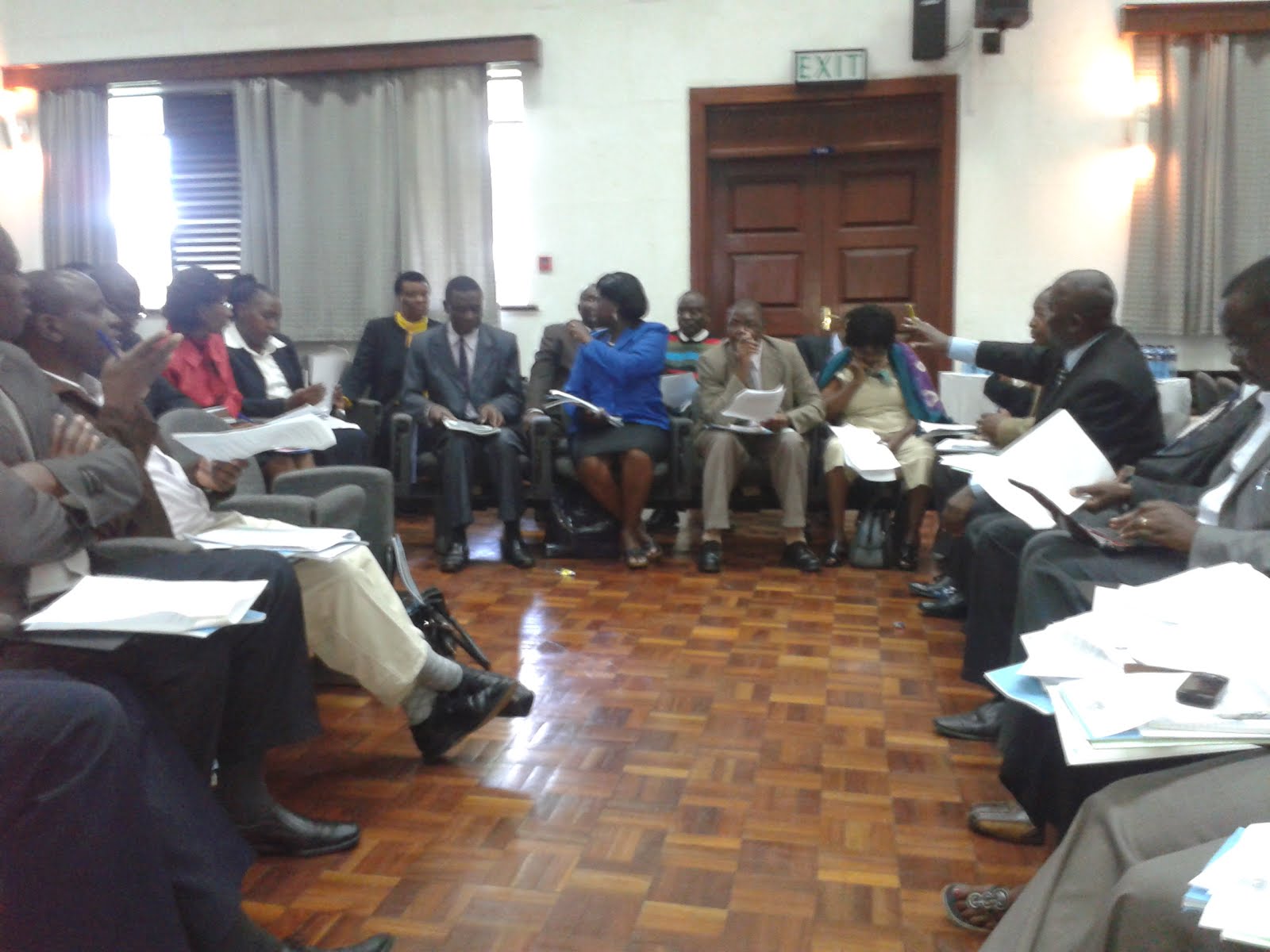

In the meantime KU legacy dissertations are starting to be digitised in order to provide full-text files to the metadata-only items that presently constitute the largest part of the KU IR. Metadata sets associated with different document types are also undergoing an update so they'll fit the requirements for providing a thorough description of the KU research output. Once this processes reach an advanced state, an advocacy campaign for further dissemination of the advantages the IR provides the KU community will be carried out at KU Schools. Ideally this should result in KU researchers and professors having the opportunity to offer their online research profiles and publications in the same way as Dr. Erik Nordman, a GVSU researcher in environmental economics who is currently spending a sabbatical year at KU School of Environmental Studies and whose publications are easy to track at his home ScholarWorks@GVSU repository.

The setting up of the KU IR will not only provide visibility for the KU scholarly output, but will also help introducing better description procedures for the Faculty members' publications. Once it gets consolidated as a fully operational reporting tool, the IR will also become the default platform for collecting the KU research output, including the journals internally published by KU Schools and Departments which are currently impossible to track online. If the IR Project at KU is able to keep its cruise speed and meet its strategic goals, the Kenyatta University Library should in the mid-term develop a research information management system as inspirating as its actual building.


With the ongoing EIFL-funded Project “Knowledge without boundaries: Advocacy campaign in Kenya for OA and institutional repositories” providing a solid platform for promoting Open Access and IRs in the country through the Kenyan Library and Information Services Consortium (KLISC), a national network of well-populated institutional repositories could soon become a reality, showing the way ahead to other East African countries.

Friday, 24 August 2012

[Open Access] Spotlight on Nairobi


  Next week a couple of interesting Open Access-related events will take place in Nairobi - making the Open Access spotlight (partly) shift away from Europe, North America and the developed countries into Kenya. It's not the first time interesting Open Access-related events happen in Kenya - a very successful BioMed Central-organised 1st Open Access Africa (OAA) Conference took place in Nairobi in Nov 2010.


Prior to briefly describing these activities, it may be useful for introductory purposes to have a look at this interesting map featured above - courtesy of Benjamin Hennig and his Social and Spatial Inequalities Research Group at the University of Sheffield, UK, based upon data kindly supplied by SPARC. The map shows a ponderated image of the world countries according to the number of Open Access dissemination activities they organised during the Open Access Week event in 2010 (the picture actually remained very much the same for OAW2011). When we look at the current geographical distribution of Open Access repositories worlwide at the OpenDOAR directory, there is a massive bias towards the developed world. However, when we check which countries are doing better in terms of promoting Open Access and establishing their own repository networks, we see both India and Kenya at the top three. In physics terminology, in order to properly describe a situation, you should both account for the actual value and the gradient of such value, gradient meaning its rate of change. So even if values may presently not look too encouraging, they will eventually change as a result of persistent efforts to drive such change.


The abovementioned Open Access activities to be held next week at two Kenyan universities in Nairobi are two good examples for those drivers for change. Kenyatta University will be hosting an Open Access workshop for raising institutional awareness of its Open Access Repository Project. This will be achieved by running different sessions along the 1-week Open Access advocacy seminar for all involved stakeholders within the University: Library and ICT Staff, Researchers from various disciplines and the Kenyatta University Management Board. Also next week, the University of Nairobi will be holding a one day workshop for the University Management Board on Open Access and institutional repositories, paying especial attention to the policy strand. This event is part of the EIFL-funded Project “Knowledge without boundaries: Advocacy campaign in Kenya for OA and institutional repositories”.

Maybe a bit more attention could be paid to Open Access advances in developing countries (even if stakeholders such as BMC and OKFN are already doing it, as well as UNESCO, IFLA and of course EIFL), since it may best serve those countries where severe restrictions to research information apply. Internet connectivity conditions permitting -still a pending issue in most African contries despite recent improvement- there will be some further reporting next week from Nairobi.