Showing posts with label institutional repositories. Show all posts

Wednesday, 19 February 2014

Integrating ORCID iDs into repositories: two tips


  Emails keep arriving these days from colleagues in different countries asking about the steps to follow in order to integrate ORCID identifiers into their institutional repositories. My regular answer to them is two-fold: “please make sure you have all your institutional ORCID iDs available before moving onto the integration process” and “please be patient and wait for a standard for technical integration to arrive from institutions already working on this area”. While the first recommendation seems quite straightforward, I am often asked to explain why I'm suggesting people to wait a bit instead of encouraging them to go ahead with their technical work. So here's the explanation:

The questions I am regularly collecting will usually deal with the best way to code the ORCID iD into a repository metadata set (usually for DSpace). Colleagues accurately guess the ORCID iD will need to be linked to the author's name, but the ways they propose to actually do this are not always identical. This would be no major issue if the objective were just featuring the ORCID iDs as an additional piece of data in the repository items, but ORCID is able to offer much more than this repository-based functionality to institutions and their scholars. The real objective of the ORCID iD integration into repositories is achieving interoperability with the ORCID profiles for researchers, enabling a two-way syncing between both systems that will allow publications hosted in the repository to be automatically displayed on the author's ORCID profile and vice-versa. This way, researchers will be spared the tedious work of manually updating their “low-profile” publications (those which won't be automatically retrieved from Scopus, the WoS or CrossRef) by having them automatically delivered by the repository, where Open Access to the full-text will usually be offered from on top of that.

In order to design and implement an effective ORCID-repository handshake, there should ideally be
oneintegration standard for each main repository platform, and this should be delivered by the repository platforms themselves – same way as if we're expecting to collect a feature to integrate ORCID iDs into Open Journal System, we would expect it to be delivered by PKP, not single institutions working independently from the system provider. This will make things much easier for ORCID – who will need to technically support just one integration process per platform and version – and also for institutions, who will be able to benefit from a tested integration mechanism already validated by colleagues at pioneering HEIs.


There is an ongoing effort in this regard since a few months ago as a result of the funding provided by the Sloan Foundation to a set ofORCID integration projects in the US, some of which are dealing with the integration of ORCID iDs into DSpace repositories. As stated in the post, "grantees (...) will share a demo of their prototype integration at the Spring 2014 ORCID Outreach Meeting to be held in Chicago on May 21-22". It's then a matter of three months to have the technical means freely available for integrating ORCID iDs into repositories in a harmonised way. When replied from the most innovative colleagues that three months is a long time, I suggest them to directly contact the University of Missouri MOSpaceRepository Team for more info – and especially to try to make sure they'll have all their ORCID iDs ready when the technical solution becomes available.


Sunday, 22 September 2013

An attempt to provide new services to the repository network in the UK: the UK RepositoryNet+ Project


  A while ago I was asked to write a brief note on the RepNet project for a the 'ThinkEPI Notes', a Spanish series of short updates on recent developments on the area of libraries and technology. Since it's a rather long text with a significant number of hyperlinks in it, I have chosen to offer it online from this blog as well so that readers may find it easier to read than via a message in a mail list. The text below is in Spanish as a result – but I shall try to provide an English translation as soon as I'm able to.

Un ensayo para el desarrollo de servicios para repositorios en el Reino Unido: el proyecto UK RepositoryNet+

El texto de esta nota está también disponible en la web de ThinkEPI.

Después de la ya tardía Declaracion de la Alhambra (mayo 2010), continúan llegando en estos días desde España noticias sobre nuevas declaraciones en apoyo del acceso abierto a nivel institucional. Aunque no completamente desprovistas de utilidad –especialmente si redundan en una mejor dotación de medios técnicos y humanos para los equipos que tratan de implantar los objetivos citados en dichos textos– estas declaraciones carecen de sentido si se limitan a ser meras expresiones de apoyo a una iniciativa próxima a cumplir diez años desde su lanzamiento [1]. Una vez que como fruto del trabajo de muchos profesionales en las bibliotecas universitarias y de centros de investigación de todo el mundo se ha alcanzado un grado de consolidación de la red de repositorios de acceso abierto que no admite vuelta atrás, el siguiente paso es aventurarse en el desarrollo de servicios sobre esa capa de infraestructura que atiendan a las necesidades de académicos e investigadores y de sus instituciones. Este es el espíritu que ha guiado el devenir del proyecto UK RepositoryNet+ en el Reino Unido [2], que se autodefine como "una iniciativa para la creación de una infraestructura socio-técnica que soporte el depósito, la curación y la difusión en acceso abierto de la literatura de investigación".

Mucho se ha hablado en este último año de la "errónea apuesta del Gobierno Británico por un modelo insostenible de acceso abierto 'dorado' (Gold Open Access) financiado mediante cuotas por procesamiento de artículos detraídas de los magros presupuestos disponibles para la investigación". Sin pretender que dicha afirmación sea completamente errónea, es preciso tener también en cuenta la cuantiosa inversión (con cifras de siete dígitos en libras esterlinas) realizada simultáneamente en una investigación sobre las vías de consolidación de la ruta verde y los repositorios de acceso abierto sin parangón en Europa [3] a través de este proyecto RepNet, apenas mencionado por contra en las acaloradas discusiones "Gold vs Green" que vienen teniendo lugar desde hace algún tiempo en las listas de distribucion de la disciplina.

Esto se debe principalmente al hecho de que, frente a la simplicidad de una política de acceso abierto concreta que es fácil juzgar y aprobar o condenar, el análisis de un proyecto tan complejo como RepNet requiere un conocimiento profundo de los retos técnicos que plantean los diferentes servicios para repositorios y de los enfoques adoptados para resolverlos por los equipos encargados de su desarrollo. De esta manera, aunque prácticamente ausente de las –frecuentemente bizantinas– discusiones entre los abogados del acceso abierto, RepNet ha sido por el contrario muy comentado y debatido por la comunidad de 'repository managers' en el Reino Unido, que es la encargada de implantar las a menudo cambiantes, cuando no contradictorias, políticas emanadas desde las distintas instancias administrativas a nivel institucional, regional o nacional.

Tal como se presenta en la página principal del proyecto, el desarrollo de servicios sobre la capa de repositorios se sustenta sobre un análisis previo de las necesidades de los diferentes actores implicados (instituciones, agencias de financiación, investigadores...) y sobre la definición de una serie de áreas de trabajo en las cuales es perentorio proporcionar nuevas funcionalidades para garantizar la continuidad de los repositorios de acceso abierto en un momento en el que las exigencias para cumplir con los requisitos de aportación de información científica que plantea el Research Excellence Framework (REF) –el ejercicio de evaluación científica que se llevará a cabo en el Reino Unido en 2014– hacen que muchas instituciones hayan optado por adquirir e implantar sistemas CRIS que a menudo amenazan con reemplazar a los repositorios de acceso abierto, pese a basarse en un enfoque mucho más centrado en la gestión de información científica que en el acceso abierto como tal [4].

Las áreas de actividad de RepNet a nivel de identificación, diseño, desarrollo e implantación de servicios para repositorios son las siguientes:

1. Agregación de Contenidos. En este ámbito, RepNet propone la construcción de un agregador de contenidos de toda la red de repositorios del país. A diferencia de muchos otros países en los que esta funcionalidad existe desde hace tiempo, en el Reino Unido no se ha consolidado ninguna de las diferentes iniciativas que han desarrollado prototipos para la agregación de contenidos. Esta desventaja a nivel de infraestructura tiene la contrapartida de que una plataforma contruida en este momento puede ofrecer funcionalidades mucho más avanzadas que las que poseen las plataformas desarrolladas con anterioridad, tales como la minería de datos sobre los textos completos de los documentos archivados con asignación automática de descriptores, la detección e integración de duplicados a partir de una estrategia similar de análisis del texto completo de los contenidos y la detección de registros metadata-only (sin texto completo asociado) incluso aunque contengan un archivo PDF por defecto o 'default dummy file' para indicar que el texto completo no está disponible. Teniendo en cuenta que la adopción de las directrices DRIVER ha sido muy escasa en el Reino Unido (lo que ha llevado a su vez a niveles de cumplimiento inusitadamente bajos de los estándares de OpenAIRE), una agregación puede ofrecer una novedosa funcionalidad de validación de esquemas de metadatos, aplicando criterios muy avanzados como los de detección de las versiones de los articulos archivados o la agregación de información de financiación de los trabajos.

      Workflow ITIL para la incubación de servicios en RepNet

2. Generación de Informes y Comparativa de Plataformas. En el area de 'reporting', RepNet viene operando el proyecto IRUS-UK [5] siguiendo un modelo común de incubación de servicios externalizados de acuerdo con la metodología ITIL [6]. IRUS-UK es un proyecto desarrollado en el Centro de Datos MIMAS de la Universidad de Manchester para recolectar estadísticas de uso de múltiples repositorios armonizadas de acuerdo con el estándar COUNTER. A mediados de septiembre de 2013, IRUS-UK recoge y agrega datos de 40 repositorios institucionales –lo que supone aproximadamente un tercio de la red nacional– y continúa extendiendo su cobertura, limitada por el momento a EPrints (29) y DSpace (11) en tanto el equipo de desarrollo trabaja en el módulo de intercambio de datos para Fedora y otras plataformas. Además de permitir la comparación para diferentes plataformas y tipos de documentos, el objetivo de IRUS-UK es obtener una estimación de las estadísticas de uso agregadas para toda la red, en la confianza de que los niveles de uso globales resultarán un argumento convincente para garantizar la utilización continuada de la misma por parte de autores e instituciones.

3. Deposito Automático de Contenidos. El proyecto Repository Junction Broker (RJB) es una iniciativa desarrollada en el EDINA National Data Centre para la transferencia automatizada de contenidos a la red de repositorios a través del protocolo SWORD. Después de varios años de trabajo, el proyecto RJB se incluyó como parte de los servicios a prestar por parte de RepNet, y ha sido bajo este paraguas cuando ha comenzado a funcionar como servicio en fase piloto desde mediados de este año [7]. RJB pretende consolidar una base de proveedores de contenido, fundamentalmente a nivel de artículos de revista, que puedan ser distribuidos, bien como registros sólo de metadatos o como metadatos+texto completo, a los diversos repositorios institucionales correspondientes a las afiliaciones de los autores de cada artículo concreto. En un principio, el RJ Broker ha firmado acuerdos con el repositorio temático EuropePMC y con Nature Publishing Group para distribuir los contenidos de ambos proveedores como proyecto piloto (el primero de ellos según el modelo 'metadata-only' y el segundo transfiriendo metadata+full-text, lo que requiere el compromiso expreso por parte de los repositorios receptores de no difundir los textos completos antes de la fecha de embargo). Un aspecto clave de la operación de este servicio es su naturaleza internacional por defecto: dado que los autores de los artículos son con frecuencia internacionales, basta con que los repositorios institucionales susceptibles de recibir información esten registrados con el servicio para que automáticamente puedan recibir los contenidos (previa instalación de SWORD) con independencia del país en el que esten ubicados.

      Servicio RJB para la distribución automática de contenidos

4. Enriquecimiento de Metadatos. El area de Metadata Enhancement es posiblemente la más amplia de las que aborda el proyecto RepNet. Fruto de las investigaciones previas sobre necesidades de los diferentes ámbitos implicados, se puso de manifiesto la existencia de estrategias para la asignación de metadatos puestas en práctica por repositorios aislados (por ejemplo en el ámbito de la preservación de contenidos) que no se difundían al resto de la red. Vista la necesidad de armonizar el desarollo de toda la red al compás, se puso en marcha la iniciativa RIOXX [8] para el desarrollo e implantacion de un 'application profile' que permitiera la incorporación conjunta de metadatos sobre financiación (algo que ya abordaba OpenAIRE para los proyectos FP7), sobre aspectos específicos relativos al acceso y sobre identificadores como ORCID. Las iniciativas preliminares para la incorporación de estos metadatos avanzados a los repositorios han comenzado a difundirse recientemente [9] de modo que puedan gradualmente adoptarse de manera conjunta por parte de toda la red.

5. Registro de Repositorios. Los dos principales directorios de repositorios existentes en la actualidad, OpenDOAR y ROAR, mantenidos respectivamente por las universidades de Nottingham y Southampton, aportan una información más que aceptable sobre la red mundial de repositorios. Sin embargo, ninguno de ambos proporciona una cobertura completa de la red. Por este motivo, y también para actualizar el perfil que los directorios proporcionan sobre las plataformas que indexan, se ha puesto en marcha como parte de RepNet el proyecto Open Access Repository Registry (OARR) [10]. Este proyecto pretende actualizar la informacion de OpenDOAR cubriendo en mayor detalle las características de los repositorios, en un momento en que tanto la implantación generalizada de sistemas CRIS como el creciente numero de repositorios de datos de investigación estan introduciendo cambios significativos en el sector. El nuevo directorio, cuyo proyecto lidera el equipo CRC-SHERPA en la Universidad de Nottingham, se alojará eventualmente en los servidores de RepNet junto a otros servicios proporcionados por SHERPA tales como RoMEO, JULIET o más recientemente, FACT. De hecho, una de las líneas para el diseño de nuevos servicios para repositorios pasa por explotar las sinergias entre estas aplicaciones gestionadas de manera integrada.

6. Localización de la Información. Una de las cuestiones más problemáticas de los repositorios hace referencia a la escasa visibilidad de sus contenidos en la red. Junto a la creación de esquemas de metadatos suficientemente comprensivos que puedan servir los propósitos de la 'discoverability', la línea de trabajo orientada a la mejora de la visibilidad de los contenidos pretende sobre todo optimizar los ratios de indexación de los materiales archivados en la red de repositorios del Reino Unido por parte de motores de búsqueda como Google Scholar o Microsoft Academic Search. Sea a través de la identificación de buenas prácticas a nivel de repositorio individual o bien a través de la indexación masiva de una agregación de contenidos [11], es preciso mejorar la visibilidad de los contenidos de los repositorios en la red, así como identificar su procedencia de modo que el usuario final de la información pueda conocer y valorar la labor realizada desde estas plataformas.

7. Preservación/Continuidad de Acceso. Sin entrar directamente en el área de la preservación digital, cubierta por otros programas y proyectos del Jisc como SPRUCE [12], el proyecto RepNet sí se planteó en cambio ofrecer alguna clase de servicio para la red de repositorios en el sentido de asegurar la continuidad de acceso a los contenidos archivados en la misma. Para ello, RepNet trabaja sobre la extensión a los materiales archivados en acceso abierto del modelo LOCKSS, ya empleado con éxito para la gestión de la continuidad en el acceso a materiales obtenidos a traves de suscripción por parte de las bibliotecas [13]. Este modelo se basa en el archivo periódico de los contenidos en una red de servidores distribuidos (las 'LOCKSS Boxes') gestionada por las instituciones.

Servicios de nueva creación Además del énfasis en la integración y ulterior desarrollo de los servicios para repositorios ya existentes, el proyecto RepNet pretende también abordar el diseño, desarrollo e implantación de una serie de nuevos servicios. Para ello, RepNet adopta el modelo para la construcción de una infraestructura (de servicios) basada en datos o 'data-driven infrastructure' [14] que permita plantear la puesta en marcha de servicios de nueva creación largamente demandados por la comunidad, tales como herramientas para la monitorización del cumplimiento de mandatos de acceso abierto. La creación de nuevos servicios se lleva a cabo mediante el establecimiento de partnerships con instituciones concretas que permitan el ensayo y testeo de desarrollos piloto. Así, la iniciativa STARS [15] llevada a cabo en colaboración con la Universidad de St Andrews y el Scottish Digital Library Consortium (SDLC) se ha planteado como una prueba piloto para la implantación del conjunto de servicios que una iniciativa como RepNet puede ofrecer a una institución y un repositorio específicos.


Referencias

[1] La Declaración de Berlín, publicada por la Sociedad Max Planck en octubre de 2003, puede considerarse razonablemente como el pistoletazo de salida del movimiento del acceso abierto con la opción que ofrecía a organismos académicos y de investigación para suscribirla de manera institucional. De hecho, la Semana de Acceso Abierto se celebra anualmente en el mes de octubre como conmemoración de la publicación de esta Declaración.

[2] Proyecto UK RepositoryNet+ (comúnmente conocido como "RepNet"), http://repositorynet.ac.uk/

[3] Sólo el proyecto europeo OpenAIRE plantea un nivel de objetivos de similar amplitud y ambición a los de RepNet a nivel de servicios a desarrollar sobre la red de repositorios de acceso abierto existente en la actualidad.

[4] En relación con el impacto sobre las instituciones del ejercicio de recopilación de información científica para el REF2014, véase la excelente presentación 'I am turning enterprisey' realizada por Chris Keene ('repository manager' en la Universidad de Sussex) en la reciente conferencia Repository Fringe 2013 celebrada en Edimburgo el pasado mes de agosto.

[5] Institutional Repository Usage Statistics (IRUS-UK), http://irus.mimas.ac.uk/

[6] Ver referencia a ITIL en la sección de preguntas frecuentes de RepNet, http://www.repositorynet.ac.uk/?q=content/faq

[7] “RJ Broker delivers its first test transfers”, http://bit.ly/16dsJmq

[8] "RIOXX: Developing Repository Metadata Guidelines", http://bit.ly/18hlzQW

[9] Nixon, W.J., Ashworth, S., and McCutcheon, V. (2013) “Enlighten: Research and APC funding workflows at the University of Glasgow”. Insights: the UKSG journal, 26 (2). pp. 159-167. ISSN 2048-7754 (doi:10.1629/2048-7754.80), http://eprints.gla.ac.uk/83882/

[10] Open Access Repository Registry (OARR), http://bit.ly/LeXGjp

[11] Kenning Arlitsch, Patrick S. O'Brien, (2012) "Invisible institutional repositories: Addressing the low indexing ratios of IRs in Google Scholar", Library Hi Tech, Vol. 30 Iss: 1 pp. 60-81, DOI: 10.1108/07378831211213210

[12] Sustainable Preservation Using Community Engagement (SPRUCE), http://bit.ly/1aXY1Vd

[13] UK LOCKSS Alliance Case Studies Now Available, http://bit.ly/18Gkw9j

[14] Informe “Preparing for Data-driven Infrastructure”, http://bit.ly/1a8SuXe

[15] Pablo de Castro, Jackie Proven, “The STARS Shared Initiative: Delivering Repository Services in an Advanced CRIS/IR Environment”. Presentación en el RepositoryFringe 2013, http://slidesha.re/1eXH2nI


Sunday, 31 March 2013

Could the so-called Gold Rush result in Green reinforcement? (II)


  A post was published last December at the UKCoRR blog examining the question of whether Green Open Access could become mainstream at Higher Education Institutions (HEIs) as a result of the policies resulting from the Finch report and aiming to drive the scholarly communication model towards a Gold OA-based one. Buiding on the discusions held at the webinar "The Role of Institutional Repositories after the Finch Report" organised by the Repositories Support Project earlier that month, the post highlighted the role IR managers were to play in explaining the different options for policy compliance at HEIs and the relevant role deposit into institutional repositories would acquire as a result of the economic impossibility to make the whole institutional research output available via Gold Open Access.

A few months later, at a time when the RCUK Open Access policy is about to come into effect, preliminary strategies for ensuring compliance are being designed at HEIs. Driven by the RCUK policy statement that "The RCUK OA Block Grant is principally to support the payment of APCs. However, Research Organisations have the flexibility to use the block grant in the manner they consider will best deliver the RCUK Policy on Open Access, as long as the primary purpose to support the payment of APCs is fulfilled", institutions are wisely investing part of the Block Grant funding on enhancing their Green Open Access infrastructure (including human resources) and making sure their institutional repository will be ready to provide support for Open Access dissemination purposes to all researchers whose publications are not awarded Gold OA funding.

In an even more inspiring realisation of this leveraging policy, the Spanish National Research Council (CSIC) released last week the requirements it will apply for authors to be eligible for Gold Open Access funding (Spanish only). With the caveat that "due to limited resources, just one article per author will be allowed per year", these include the need to deposit the author's research outputs published in the last three years into the Digital.CSIC institutional repository in three months time since the funding for the payment of APCs has been awarded.

Compliance monitorisation is becoming a key concern at HEIs as a result of these policies and attempts at having pilot systems in place for ensuring the reporting tools for policy compliance are available will shortly be carried out at pioneering institutions. In the meantime the whole move towards Gold and Green Open Access remains a daring experiment whose outcome -including the way researchers in different domains are willing to follow the policy guidelines- will be very interesting to follow in upcoming months. The Global Research Council meeting in Berlin next May 2013 will provide a good opportunity to agree on an international action plan for implementing Open Access to Publications – Open Access implementation is one of only two items on the agenda.


Tuesday, 26 March 2013

Primer proceso de creación automática de ORCIDs a nivel institucional


  Con fecha 25 de marzo se ha realizado desde la Universidad de Oviedo (UniOvi) el primer ensayo exitoso de creación automática de ORCIDs para autores institucionales desde la Biblioteca. El proceso consistió en la ingestión de una modesta primera tanda de 10 ficheros XML de autores UniOvi en la API de ORCID en producción. Como resultado de este proceso se crearon 9 perfiles ORCID, y un décimo fue identificado como un potencial duplicado y se reportó como tal al administrador. A continuación se ofrece una breve descripción del proceso que condujo a este resultado.


El proceso

Tras un intenso esfuerzo de difusión de ORCID en el país, la Universidad de Oviedo devino el pasado mes de diciembre el primer miembro institucional de ORCID en España. Una vez firmado el acuerdo con ORCID, UniOvi decidió que serían la Biblioteca y su Jefe del Servicio de Información Bibliográfica María Luisa Alvarez de Toledo las responsables de la adopción institucional de ORCID en la Universidad. Además de apoyarse en el servicio de soporte técnico de ORCID – muchas gracias a Catalina Oyler en este sentido – la Biblioteca UniOvi decidió contar también con el apoyo de GrandIR para este propósito. GrandIR había organizado la sesión técnica sobre ORCID el anterior mes de septiembre y estaba muy involucrada en la difusión y la adopción de ORCID, de modo que esta colaboración se perfilaba como una buena oportunidad para poner a trabajar los conocimientos adquiridos en el proceso.

El primer paso en el camino hacia la adopción institucional de ORCID por parte de UniOvi fue definir una estrategia para la creación institucional de ORCIDs y su implantación en los sistemas de gestión de la información científica de la Universidad. La Biblioteca UniOvi mantiene un registro de todos los autores institucionales en una tabla en la que figuran también sus firmas más frecuentes e identificadores tales como ScopusID o ResearcherID – que con frecuencia son asimismo gestionados directamente desde la Biblioteca. Esta tabla se empleó para generar ficheros XML de los autores UniOvi listos para introducir en la API de ORCID.

A continuación se realizó una etapa de testeo: a partir de los ficheros XML se generó una serie de perfiles ORCID de prueba desde la línea de comandos del entorno de pruebas OAuth de ORCID. Estos ensayos fueron exitosos y permitieron testear la configuración particular de los XMLs en aspectos tales como la codificación de caracteres o el uso de caracteres especiales característicos de la lengua española. Sin embargo, la necesidad de operar desde la línea de comandos hacia que la creación de los perfiles ORCID resultara un proceso muy lento, que podía valer para crear ORCIDs para unos pocos autores, pero no para la generación de perfiles para el conjunto de autores de la institución. Se decidió entonces desarrollar una aplicación que permitiera crear ORCIDs de manera automática para un gran número de autores, tarea que se encomendó a GrandIR. Unas semanas después el primer prototipo estaba disponible para realizar pruebas 'en real' sobre el entorno de producción de ORCID. Estas pruebas arrojaron como resultado la introducción de 10 ficheros XML de autores UniOvi en la API de ORCID y la creación automática de 9 nuevos perfiles ORCID. La mayor parte de estos perfiles se encuentra aún pendiente de ser reclamada por los autores - y de hecho el ritmo de reclamación de los perfiles es uno de los aspectos que la Biblioteca está monitorizando antes de planificar ulteriores estrategias de difusión de ORCID a nivel interno.


Los retos

A lo largo del proceso que ha llevado a la creación automática de ORCIDs se ha resuelto toda una serie de retos. El principal entre ellos se deriva de ser la Universidad de Oviedo la primera institución en el mundo que ha realizado la mayor parte de los procesos, desde solicitar y utilizar sus credenciales de usuario hasta aprender a manejar las APIs de ORCID. El hecho de que ORCID se encuentre aun en un estado relativamente temprano de desarrollo también supuso una dificultad en algunos momentos, dado que ocasionalmente implicaba colaborar directamente con ORCID en la definición del procedimiento para realizar determinados procesos. Finalmente, la necesidad de apoyarse en un único servicio de soporte técnico de ORCID con su horario temporal específico fue asimismo una de las consecuencias del papel pionero adoptado por la Universidad.

Uno de los grandes retos que afronto la Biblioteca UniOvi – uno que sera además relativamente frecuente en otras instituciones – fue la falta de soporte técnico interno específico para la tarea. Esta dificultad se pudo superar no obstante gracias al apoyo proporcionado tanto por ORCID como por GrandIR.

Dos son los ámbitos adicionales en los que existen aún retos por resolver antes de lograr una adopción amplia de ORCID en la Universidad. El primero de estos ámbitos es cultural, y conlleva implicar a los autores en el proceso de reclamación, alimentación y utilización de sus ORCIDs. Esto debería basarse en buena medida en la definición y difusión de bunas prácticas. El otro ámbito en el que quedan retos por resolver es el técnico: en primer lugar hace falta un procedimiento para identificar con garantías los potenciales duplicados y posiblemente para fusionar perfiles ORCID creados sobre direcciones de correo diferentes de un mismo autor. Además de esto, la Biblioteca desearía contar con los permisos necesarios para poder mantener los perfiles ORCID de nueva creación y para ser capaz por ejemplo de reclamar publicaciones en nombre de los autores. Estas son áreas en las que ORCID está desarrollando su trabajo en este momento, y a medio plazo se podrá contar con las funcionalidades necesarias para abordar estos retos.

El resultado

El principal resultado del proceso hasta ahora ha sido el intento, tan exitoso como modesto, de crear automáticamente perfiles ORCID para unos pocos autores UniOvi desde la Biblioteca. Sin embargo, una vez que se han creado los primeros ORCIDs, extender su cobertura hasta abarcar la totalidad de los autores UniOvi no supone grandes retos técnicos. Además de esto, el éxito preliminar en la identificación de duplicados por parte de la aplicación para la creación automática de ORCIDs supone un primer paso en la definición de criterios que permitan asegurar la detección de potenciales duplicados como parte del proceso de creación automática de ORCIDs. La Biblioteca tiene ahora la oportunidad de examinar el proceso de reclamación de ORCIDs por parte de los autores – junto a la ocasión de proporcionar feedback durante el proceso, por ejemplo sugiriendo la posibilidad de permitir una personalización del mensaje de bienvenida por parte de la institución miembro a través de un panel de opciones que permita seleccionar el idioma en que se recibe el mensaje de bienvenida. Por otro lado la Biblioteca está ya diseñando estrategias institucionales de difusión, incluyendo una breve Guía de Reclamación de ORCIDs para los autores y un sitio web institucional que ofrezca una introducción a ORCID y un resumen de sus principales beneficios para los autores y para la Universidad. Todos estos contenidos deberían ser en buena medida reutilizables por las instituciones que se unan a ORCID de ahora en adelante.

El camino pendiente

Los siguientes pasos a dar para completar el trabajo son en primer lugar extender este desarrollo piloto hasta proporcionar cobertura a todos los autores UniOvi. Una vez que se logre esto, debe desarrollarse una estrategia para implantar los nuevos ORCIDs en los sistemas institucionales, comenzando con el repositorio institucional RUO. La implantación de ORCID en el repositorio debería suponer un medio para atraer a los autores hacia él y asegurarse de que aquellos autores que aún no han depositado ningún trabajo en el repositorio se percaten de los servicios de valor añadido que éste puede proporcionarles.

Finalmente, una buena parte de las tareas pendientes pertenece al ámbito de la difusión: desde la Biblioteca se pretende promover una serie de buenas prácticas para el uso de los ORCIDs por parte de los autores institucionales. Además de esto, una vez que se complete el proceso, la Biblioteca está también interesada en difundir las buenas prácticas para la adopción institucional de ORCID a través de un canal más riguroso que un mero post, por lo demás el medio más rápido para dar a conocer y compartir los progresos realizados.

First successful automated ORCID creation at institutional level


  On March 25th a first successful attempt was made at Universidad de Oviedo (UniOvi) for an automated ORCID creation process for institutional authors. A modest first batch with 10 XML UniOvi author files was fed into the production ORCID API and 9 ORCID profiles were successfully created – with the 10th being identified as a potential duplicate and subsequently reported. A brief description of the process that lead to this result is provided below.


The process

Following extensive ORCID outreach activities in the country, Universidad de Oviedo became the first institutional ORCID member in Spain last December. Once the membership was signed, the decision was made for UniOvi Library and its Bibliographic Information Service Manager Maria Luisa Alvarez de Toledo to become responsible for ORCID adoption at UniOvi. Besides relying on the ORCID technical support service -a big thanks to Catalina Oyler here- UniOvi decided to also contact GrandIR for the purpose. GrandIR had organised the ORCID technical session earlier in September and was very much involved into ORCID dissemination and adoption, so it looked like a good opportunity to put this knowledge to use.

The first step towards ORCID adoption at UniOvi was to define a strategy for institutional ORCID creation and implementation into UniOvi research information management systems. The Library keeps a registry for all UniOvi authors, together with their most frequent signatures and identifiers such as ScopusID or ResearcherID - which are often managed from the Library too. The process involved XML UniOvi author file generation so that these could be fed into the ORCID API.

A testing stage followed: a number of mock ORCID profiles were generated on ORCID OAuth Playground testing environment via the command line. These were successful and allowed to test specific XML configuration with regard to character coding and special characters often found in Spanish names. However, the need to operate from the command line made the ORCID generation process quite a slow one, which would suit the purpose of creating ORCIDs for a few authors, but certainly not for all UniOvi scholars. The decision was then made to develop an application that would allow automated ORCID creation for a large number of authors, and GrandIR took on the challenge. A few weeks later, a first prototype was available for live testing on ORCD production environment. These first tests resulted in 10 XML author files fed to the ORCID API and 9 new ORCID profiles created. Most of these new ORCIDs are still pending claim by authors - and in fact the claiming rate by authors is one of the aspects the Library is looking at before planning further internal outreach strategies.


The challenges

A number of challenges have already been tackled along the way to automated ORCID creation. The main one among these is a consequence of UniOvi being the very first institution to carry out most of the procedures, from requesting and using its credentials to learning how to operate the ORCID APIs. The fact that working together with ORCID was occasionally required to define how specific processes should be carried out was sometimes a bit challenging – but certainly fun as well. Finally, the need to rely on a single-point ORCID technical support service (running on a specific time zone) was also one of the consequences of the pioneering role UniOvi took that will presumably be improved in the future.

One of the big challenges that the UniOvi Library faced – and this will probably be quite frequent at other institutions – was the lack of specific internal technical support for the task. However, this issue could be overcome thanks to the support provided both by ORCID and GrandIR – and it should by no means discourage institutions interested in becoming ORCID adopters, since from now on there will be a growing network of supporting colleagues and institutions available to help.

There are two additional strands in which challenges remain before a far-reaching ORCID adoption is achieved at the University. The first one is cultural, and involves engaging authors into the process of claiming, completing and using their ORCIDs. This should very much be based on a best practice definition and dissemination. The other domain where challenges are still to be tackled is the technical area: first, there is a need for a reliable identification of potential duplicates and possibly for merging ORCID profiles created on different author email addresses, and then, the Library would also wish to have privileges for maintaining the newly-created ORCID accounts and be able for instance to claim publications on behalf of the authors. These are areas where current ORCID work is taking place, and new features will be available in the mid-term that will enable this functionality.

The outcome

The main process outcome has so far been a successful (if humble) attempt for automatically creating ORCID profiles for a few UniOvi authors from the Library. However, once the first ORCIDs were created, extending the coverage to the remaining UniOvi authors poses no major technical challenge. Furthermore, the successful identification by the application for automated ORCID generation of a previously existing ORCID for one of these 10 authors was a first step in putting together a set of criteria that will ensure detection of candidates for duplicated entries at ORCID creation time.

The Library has now the opportunity to test the process for ORCID claiming by authors - together with the opportunity to provide useful feedback along the process, for instance by suggesting that it might be useful to allow the welcome message to be customised by the member institution through an option panel that would allow to choose things such as the language the welcome message is written in. Institutional outreach strategies are already being designed, including a brief guide on ORCID claiming for authors and an institutional ORCID website providing an introduction to ORCID and explaining what its benefits are both for authors and the institution itself. All these contents should very much be re-usable by institutions which join ORCID from now on.

The way ahead

The next steps for completing the work are in the first place extending the pilot to cover the whole set of UniOvi scholars. Once this is achieved, strategies are to be designed for implementing the new ORCIDs on institutional systems, starting with the DSpace-based institutional repository RUO. Ideally, ORCID implementation on the repository will provide a means to engage authors with it and ensure that those authors who have not deposited anything yet in the repository will realise some of the value-added services it may provide them.

Finally, a great deal of the remaining tasks fall into the outreach domain: best practices for ORCID use by institutional authors are to be promoted from the Library as part of an awareness raising campaign about ORCID. Besides this, once the process has been completed, the Library has the intention to disseminate best practices in ORCID adoption at institutional level through a somewhat more rigorous channel than a blog post.

Tuesday, 18 September 2012

Discussing ORCID... and the Gold vs Green controversy


  A new GrandIR technical session was held on Sep 6th at the Open University of Catalonia (Universitat Oberta de Catalunya, UOC) in Barcelona. This new workshop was devoted to Author IDs and ORCID (Open Researcher and Contributor ID) and brought together representatives from the various stakeholders concerned by the launch of the ORCID service, to take place next Oct 15th. The event programme included ORCID themselves (Martin Fenner, Chair of the ORCID Outreach Working Group), National author ID initiatives (Amanda Hill, Names Project UK), funders (Gerry Lawson, Natural Environment Research Council, NERC), National Research Offices (David Arellano, Spanish Foundation for Science and Technology, FECYT) and publishers/vendors (Philip Purnell, Thomson Reuters). Each of the speakers delivered a presentation (files are downloadable from the session programme) and a round table was held afterwards in order to discuss the requirements for an universal author identifier as well as its implications and challenges.

A summary of the session discussions follows:
    • - ORCID service is set to be launched Oct 15th. Martin Fenner provided an up-to-date view of the ORCID interface as it stands right now, although -he mentioned- it keeps evolving every day.
      - ORCID business model is currently being established along the following lines: the service will be free for individual authors/researchers, and there will be a fee for institutions, to be classified as small or large. Charge for small ones will be $4,000 per year. Overlay services will gradually be made available.
      - ORCID will run different strategies for buiding up an author database: (free) individual registration for authors, collective registration for institutions (for a fee), collection & upgrade from other existing author IDs - such as ThomsonReuters ResearcherID, Scopus Author Identifier, arXiv, etc.
      - ORCID duplication may result from overlapping registration strategies - some dissambiguation work should be required to clear those. ORCID won't be providing this service (at least not at launchtime, although possibly later on), so this might be a potential role for National Author ID projects (such as Names, DAI or Lattes) which lie closer to the authors.
      - Two main workflows have been designed so far for promoting ORCID use: (i) Publisher Workflow, meaning publishers will request ORCIDs to authors at manuscript submission time, and (ii) Funder Workflow, by which funders will request ORCIDs to researchers at grant bid submission time. Several publishers are already working to enable ORCID collection, and research funders are happy to be able to work with a non-profit initiative instead of commercial providers.
    • - Institutions running a CRIS system will be better positioned for ORCID implementation, once the required datamodel updates are performed (euroCRIS CERIF TG is currently working on CERIF datamodel enhancement in order to bring persistent identifiers into the system). For those HEIs not running CRIS Systems (for which CERIF is incidentally not a requirement), Institutional Repositories may as well play a key role for ORCID implementation purposes.
      - There are a number of author ID-related services that ORCID will not aim to provide. Among these, organisation IDs, citations, usage or other value-added services. ORCID actually aims to provide a basic feature (namely author identifier plus attached publications) on top of which other stakeholders are expected to build value-added services. ThomsonReuters ResearcherID (as well as other commercial or national author ID services) is therefore not planned to be superseded by ORCID, but they will co-exist instead.
      - One month away from service launch, there are several important factors that remain unclear, such as the service takeup by authors, the project timeschedule or the level of duplication that may result from overlapping registration strategies. Strategies for service dissemination among the research community remain also to be defined to some extent. However, meetings like the one held in Barcelona or the upcoming one at Humboldt-Universität in Berlin will certainly support awareness-raising among the research community.

  • Finally, the meeting in Barcelona also offered the opportunity to discuss with Gerry Lawson, UK Natural Environment Research Council (NERC), whether the RCUK policy for promoting Gold OA as a default option for complying with their Open Access policy turned the Research Council into "traitors" to the Open Access movement. When offered the opportunity to discuss their view, he said the Coucils were by no means opposed to Green OA - only after ten years work, repositories were still not complying the funders' requirements for tracking Open Access outputs and payments.

    Discussions on the default Gold OA direction the UK has taken following the release of the Finch Report should also account for this current reporting shortcomings in Green OA infrastructures. At the same time, requests for turning the RCUK OA Policy a more balanced supporting tool for both Gold and Green OA seem indeed reasonable enough.

    In summary, the session was very useful for disseminating the current state of the ORCID initiative on the verge of its being released and for discussing its implications and challenges for organisations and initiatives potentially involved in its roll out as a service to researchers and the wider community. Some additional session outcomes are starting to surface as requests for further ORCID dissemination at given universities in Spain - more information on this will be provided in due time. The ORCID Service launch meeting in Berlin next October will also provide new insights on the service that will be dutily reported.

    Video recordings of the interventions will shortly be made available at the UOC O2 Institutional Repository. A useful session summary in Spanish has also been published by Elvira Santamaria at the EPI Blog.

    Thursday, 13 September 2012

    Steady progress of Open Access at Kenyatta University and beyond


      As shown in the Open Access trend worldmap in the previous post, Kenya may well be the country where a strongest impulse towards Open Access implementation in a coordinated, cross-institutional way is currently under way. A high number of Kenyan universities are taking steps to issue Open Access policies and to set up their institutional repositories. These include Maseno University, which has recently become the first signatory of the Berlin Declaration on Open Access in Kenya, Kenyatta University, which is about to adopt an institutional Open Access policy and is already running its own IR, Moi University, University of Nairobi and JKUAT, which has recently issued a Digital Repository Policy document so well drafted that it may become a source of inspiration for many other institutions in the continent.

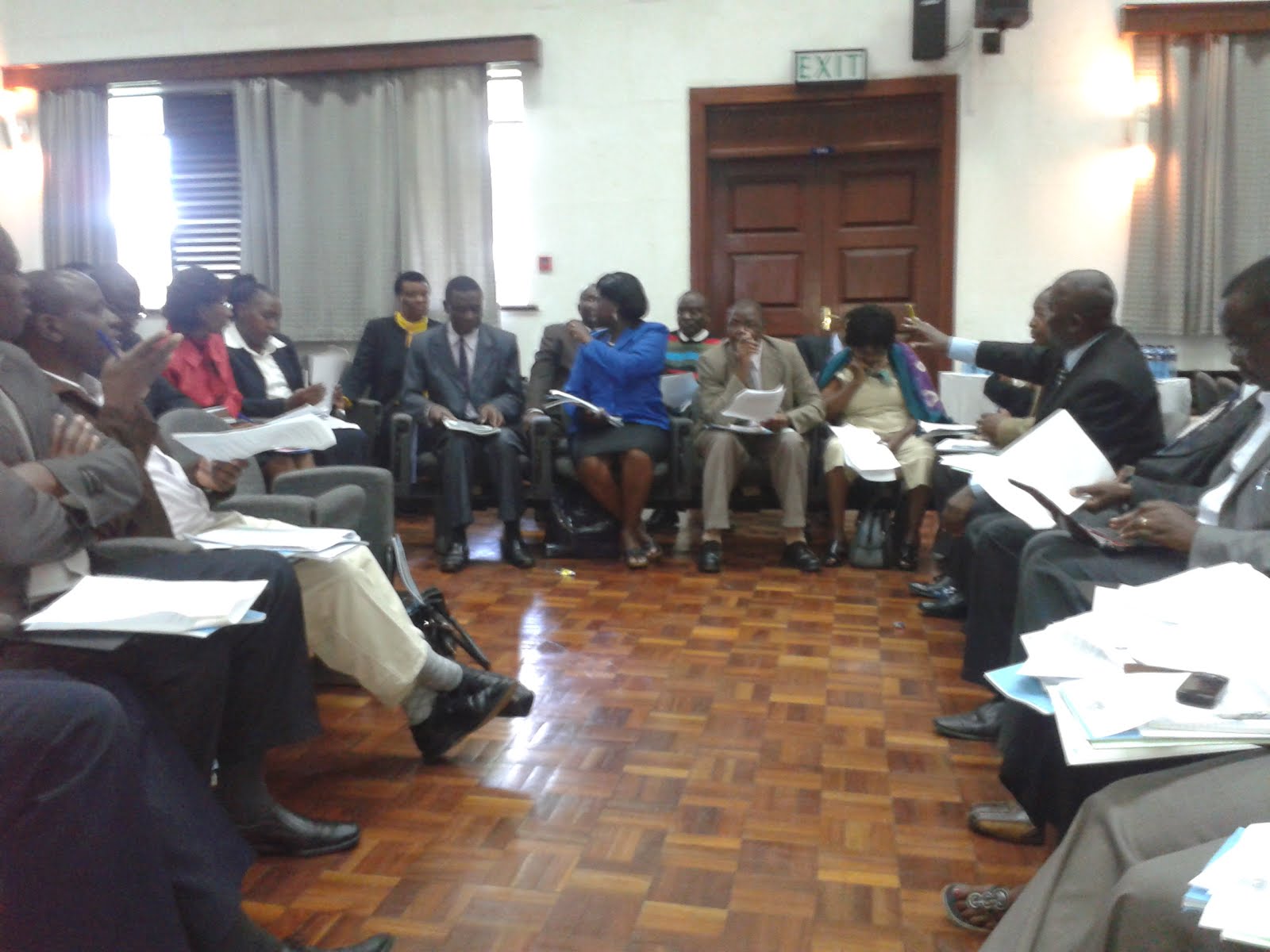
    Efforts during the Open Access activity week at KU were aimed to train the Kenyatta University IR and ICT staff and KU researchers and Management Board on Open Access and on how to deal with the new institutional repository which is being developed by the University Library. The 2-day seminar held at the Kenya School of Monetary Studies (KSMS) -organised by Reuben Njuguna, KU Dept. of Business Administration- provided the summit in the OA advocacy sessions held during the week. The first day of this event was devoted to introducing Open Access and its current worklines to the KU Management board, with talks by Gitau George Njoroge, Director of KU Library, Iryna Kuchma, EIFL Open Access Programme manager, William Nixon, Digital Library manager at the University of Glasgow and Brian Hole, manager of the Ubiquity Press Open Access publisher. The second day a round of group discussions was held among the KU VCs and professors in order to establish the guidelines for a draft Open Access policy for KU, which is now under review by the KU Law Department in order to make it final.


    In the meantime KU legacy dissertations are starting to be digitised in order to provide full-text files to the metadata-only items that presently constitute the largest part of the KU IR. Metadata sets associated with different document types are also undergoing an update so they'll fit the requirements for providing a thorough description of the KU research output. Once this processes reach an advanced state, an advocacy campaign for further dissemination of the advantages the IR provides the KU community will be carried out at KU Schools. Ideally this should result in KU researchers and professors having the opportunity to offer their online research profiles and publications in the same way as Dr. Erik Nordman, a GVSU researcher in environmental economics who is currently spending a sabbatical year at KU School of Environmental Studies and whose publications are easy to track at his home ScholarWorks@GVSU repository.

    The setting up of the KU IR will not only provide visibility for the KU scholarly output, but will also help introducing better description procedures for the Faculty members' publications. Once it gets consolidated as a fully operational reporting tool, the IR will also become the default platform for collecting the KU research output, including the journals internally published by KU Schools and Departments which are currently impossible to track online. If the IR Project at KU is able to keep its cruise speed and meet its strategic goals, the Kenyatta University Library should in the mid-term develop a research information management system as inspirating as its actual building.


    With the ongoing EIFL-funded Project “Knowledge without boundaries: Advocacy campaign in Kenya for OA and institutional repositories” providing a solid platform for promoting Open Access and IRs in the country through the Kenyan Library and Information Services Consortium (KLISC), a national network of well-populated institutional repositories could soon become a reality, showing the way ahead to other East African countries.

    Monday, 28 May 2012

    Conclusiones 5as Jornadas OS Repositorios (Bilbao, Mayo 23-25, 2012)


      Los pasados días 23 a 25 de mayo se celebró en la Escuela de Ingenieros de Bilbao de la Universidad del País Vasco/Euskal Herriko Unibertsitatea (UPV/EHU) una nueva edición de las Jornadas OS Repositorios, el evento de ámbito nacional más importante de la comunidad de acceso abierto y repositorios en España. En un momento en el que la infraestructura de repositorios de acceso abierto en España puede considerarse bastante consolidada, y en una situación económica que exige racionalizar costes e inversiones, esta quinta edición de las Jornadas, organizada conjuntamente por la UPV/EHU, la UNED y el Grupo Acceso Abierto liderado por Reme Melero, ha resultado más interesante aún si cabe que anteriores ediciones de las mismas. Se ofrecen a continuación algunas reflexiones sobre el evento a modo de conclusiones personales resultado de las conversaciones con compañeros de GrandIR, UPC, UPV/EHU, CSIC, UNED, UA y otra serie de instituciones.

    Aunque siguen presentándose en las jornadas repositorios institucionales de acceso abierto de nueva creación –tal como el Archivo Digital para la Docencia y la Investigación (ADDI) de la UPV/EHU que presentó su responsable Alcira Macías– son cada vez más abundantes las reflexiones del tipo "ya tenemos un repositorio consolidado: ¿qué hacemos a continuación?". Este fue el caso de Javier Gómez Castaño, manager del repositorio RUA de la Universidad de Alicante en su presentación "Facilitando el autoarchivo en el repositorio institucional: el caso de la Universidad de Alicante".

    Esta edición de las Jornadas, titulada "la motricidad de los repositorios de acceso abierto", ha ofrecido un buen número de respuestas a la pregunta de "y ahora, ¿qué hacemos?". Cabría sintetizar en tres grandes grupos las propuestas de avance debatidas a lo largo de las sesiones de estas 5as Jornadas:
    • Integración CRIS/IR e implementación de CERIF
    • Funcionalidades adicionales para los repositorios
    • Linked Open Data (LOD) & Research Data Management (RDM)

    1. La conferencia inaugural de Keith Jeffery, presidente de euroCRIS, estuvo dedicada en exclusiva a la integración de los repositorios de acceso abierto con los sistemas CRIS (Current Research Information Systems o Sistemas de Gestión de la Información Científica) y a la paulatina adopción de CERIF como estándar de descripción. En ella se describió la situación en el Reino Unido, el país europeo más avanzado en la implementación de CERIF y de los sistemas CRIS como consecuencia de su utilidad para el cumplimiento del ejercicio de evaluación de la actividad científica Research Excellence Framework (REF) que tendrá lugar en 2014.


    Keith habló de la integración de los sistemas CRIS, los repositorios de publicaciones y los repositorios de datos y software como modelo de desarrollo de la infraestructura institucional que puede prestar un servicio más completo a los investigadores, y proporcionó una serie de justificaciones sobre por qué CERIF es más apropiado como estándar de descripción de objetos que DublinCore, mencionando entre otros la ambigüedad entre autor e institución en dc.creator, las relaciones insuficientemente precisas a nivel general y la semántica y la sintaxis poco evolucionadas.

    Asimismo Keith describió el modelo Gold Open Access al que parece tender el mercado como económicamente insostenible para las bibliotecas de las instituciones con elevado volumen de publicaciones y abogó en su lugar por un alejamiento del modelo basado en los artículos de revista para volver hacia "algo similar al modelo Philosophical Transactions", con comunicaciones más en la línea de blogs y "conversaciones científicas".

    A lo largo del keynote speech se describió también cómo los modelos más avanzados de sistemas CRIS en el Reino Unido están incorporando las funcionalidades de los repositorios institucionales hasta hacerlos redundantes y llegar eventualmente a plantearse su retirada de servicio. Finalmente, el take-home message de la conferencia inaugural fue que para el usuario final lo fundamental es la prestación del servicio que necesita, y no tanto el modo en que se configura la arquitectura de las plataformas de datos que hacen posible dicho servicio.

    Todos estos temas volverán a tratarse de manera más amplia a principios de junio en la próxima conferencia CRIS2012 en Praga y en el Autumn 2012 euroCRIS membership meeting en Madrid el próximo mes de noviembre, en la que se abordará asimismo el nivel de avance de la implementación de sistemas CRIS en España.


    2. Funcionalidades adicionales para los repositorios. Una vez consolidados los repositorios como sistemas de gestión y difusión de la producción científica, cabe plantearse su utilización como puerta de entrada de funcionalidades novedosas a los sistemas institucionales de gestión de la información científica. Entre estos nuevos servicios cabe citar la introducción de esquemas internacionales de identificación persistente de autores e instituciones como ORCID (abordada en la presentación de la Fundación DIALNET por Eduardo Bergasa), la normalización de las estadísticas de uso a nivel nacional e internacional, el progreso de la incorporación de contenidos OpenAIRE a los múltiples repositorios que cumplen ya sus directrices en España (ambos aspectos mencionados por Pedro Príncipe, Universidade do Minho, y por Cristina González Copeiro, FECYT) o el desarrollo de vocabularios controlados que puedan facilitar la alineación de los contenidos en torno a directrices temáticas tal como explicó Leticia Barrionuevo, gestora del repositorio Bulería de la Universidad de León.

    Diversas ponencias a lo largo de las jornadas hicieron énfasis también en la conveniencia de desarrollar funcionalidades de redes sociales sobre los repositorios de acceso abierto, en la línea de soluciones como ResearchGate que permite la implantación de alertas temáticas y de grupos de discusión científica en torno a aspectos concretos.


    3. Linked Open Data (LOD)/Research Data Management (RDM). Estos dos temas, y más en general la cuestión de la gestión de los datos de investigación por parte de las instituciones fueron repetidamente abordados por diversos ponentes en las Jornadas. Aunque no hubo consenso respecto a la conveniencia de poner en marcha iniciativas RDM a nivel institucional en tanto no se obtengan garantías de una financiación específica y sostenida de las mismas, hubo un amplio debate sobre las políticas y la infraestructura a desarrollar en este ámbito.

    Entre las presentaciones que abordaron la gestión de los datos cabe destacar la de Alvaro Rodríguez Miranda, del Laboratorio de Documentación Geométrica del Patrimonio (LDGP) de la UPV/EHU en Vitoria, que presentó una iniciativa pionera de archivo de datos de patrimonio en el repositorio institucional ADDI y la de Alicia García, Universidad Católica de Valencia, que presentó el portal ODiSEA, un directorio internacional de repositorios de datos. Tanto Pedro Príncipe como Cristina González Copeiro hablaron de OpenAIREplus, el proyecto-continuación de la Comisión Europea para extender OpenAIRE al ámbito de la RDM siguiendo el modelo ‘Enhanced publications’, y Jordi Serrano (SBD-UPC) y Ricard de la Vega (CESCA), miembros ambos del Grupo de Trabajo FECYT/Recolecta sobre Repositorios de Datos, estuvieron particularmente activos en el debate sobre gestión de datos de investigación.

    Por su parte, Tránsito Ferreras, repository manager del repositorio Gredos de la Universidad de Salamanca, presentó la ponencia "Influencia de Linked Open Data sobre repositorios Open Access: Un caso práctico", en la que introdujo las iniciativas LOD que está poniendo en marcha el equipo de Gredos para adoptar el modelo de datos de Europeana (EDM). También Alicia López Medina, UNED y Directora Ejecutiva de COAR, mencionó varias veces a lo largo de sus intervenciones que los contenidos de los repositorios deben exponerse a los proveedores de servicios como un conjunto de objetos digitales complejos con enlaces internos entre sí que dichos proveedores puedan emplear como base para sus desarrollos.

    Reseñar por último como momentos destacados de estas 5as Jornadas la presentación retrospectiva de la historia del evento OS Repositorios desde su arranque en diciembre de 2006 en Zaragoza por parte de Reme Melero y la iniciativa pionera de programar presentaciones pecha kucha en la sesión de intervenciones breves. A este respecto, nos atrevemos a hacer desde aquí dos sugerencias: primera, la creación de un sitio web permanente de las Jornadas OS Repositorios en la que se recopilen materiales tales como un histórico de presentaciones cada vez más difíciles de rastrear en Internet. Y segunda, la creación de un premio a la mejor presentación pecha kucha –que GrandIR estaría por su parte encantada de patrocinar– que fijaría por un lado la atención de la audiencia que ha de seleccionar la mejor presentación, y estimularía también el espíritu competitivo de los ponentes.

    Tuesday, 22 May 2012

    EIFL Workshop on Open Archives in Monastir


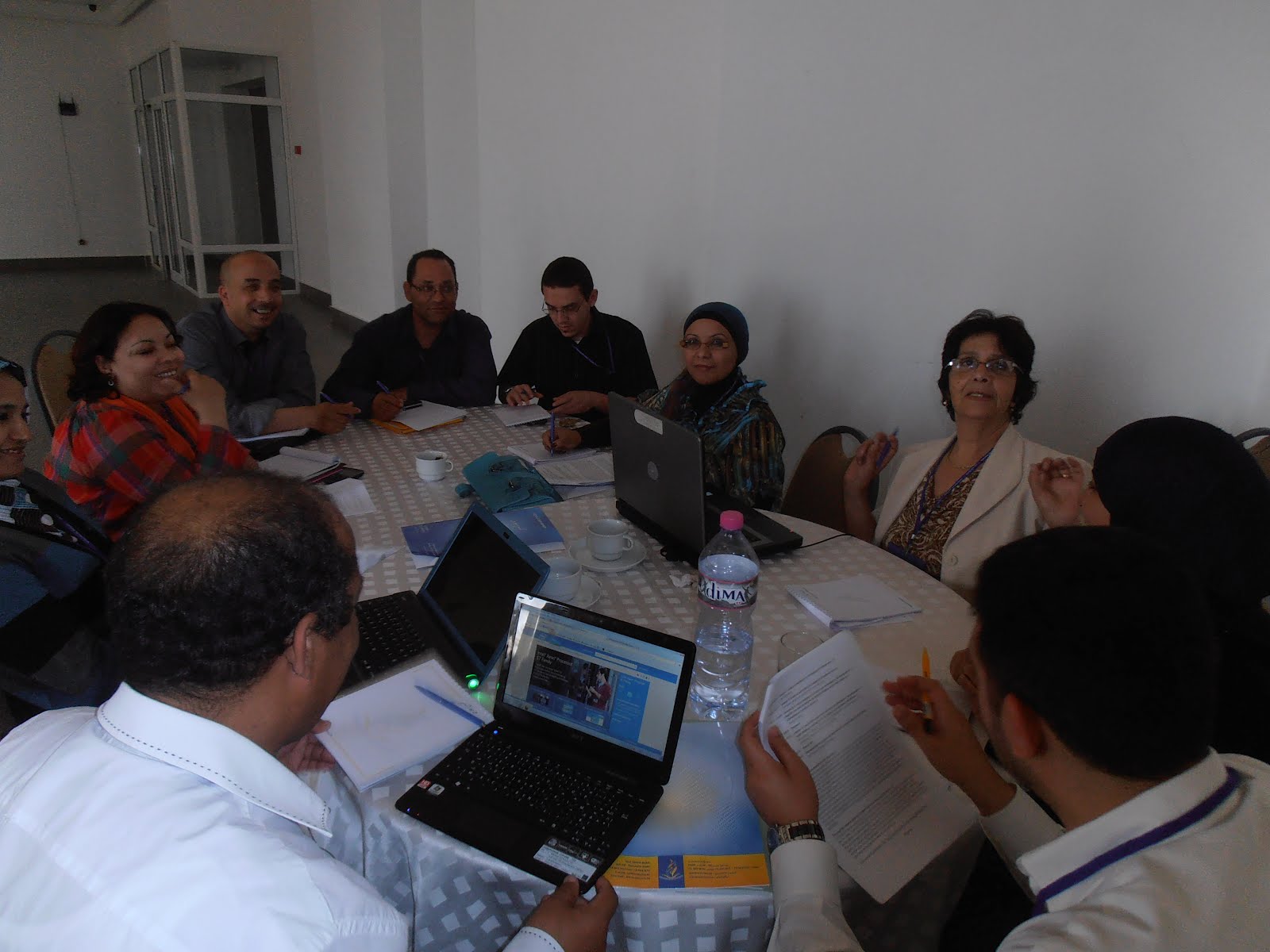
      GrandIR has just taken part in the 'Atélier sur les archives ouvertes' organised last week (May 14-15) in Monastir, Tunisia, by EIFL for promotion and dissemination of Open Access and Open Archives in the Maghreb countries. This workshop was held in the framework of the European Tempus ISTeMag Project for improving access to Scientific and Technical Information in the Maghreb universities. Led by the Université Libre de Bruxelles, this project features twelve universities and research centres in Tunisie, Algeria and Morocco among its partners. As a consequence, the Open Archives workshop in Monastir was well attended by over 30 Maghrebi librarians, developers, research officers, project coordinators and policymakers from all three countries.

    Iryna Kuchma, EIFL Open Access Programme Manager, designed a comprehensive programme for the event along with the Tempus project coordinators. The programme covered all aspects of Open Archives, from its benefits to research activity to the obstacles faced for seting them up, from the strategies to develop a repository to copyright, marketing, policies and best practices. In order to provide the expertise, EIFL recruited a few European colleagues who delivered presentations and acted as facilitators for the group debates. Among these experts were Jean-François Lutz, Head of Digital Library at the Université de Lorraine and Pablo de Castro, Director of GrandIR.

    There were several group sessions along the 2-day event, in which representatives of various professional profiles from different institutions -and often different countries- engaged in a lively debate and discussed their complementary approaches to specific aspects of Open Access policies, content gathering or marketing activities. Since ISTeMag has already held previous meetings to examine the different aspects of access to scientific and technical information (the most recent one took place last November in Algiers), workgroups discussions were in some sense a follow-up to a more general debate on access.

    A Moroccan colleague kindly shared a ranking of universities in the Maghreb countries along the event - featured below. It's interesting to see that there are six Tunisian universities in the top ten, and that three of these top ten-ranked universities are partners in the Tempus ISTeMag Project (two Tunisian, Sfax and Monastir, and one Moroccan one, Marrakesh-Cadi Ayyad). It's also worth mentioning that having an open archive or institutional repository in place will significantly improve the position of a university in these rankings (see also in this regard the Top Africa section in the Web Ranking of World Universities released every six months by the CCHS-CSIC Cybermetrics Lab in Madrid, in which Maghreb universities could probably do better in a global African context).


    There are already a few running Open Access repositories in Maghreb countries, with many more in project or in pre-production stages, but there is still a long way to go until the region reaches the level of infrastructure available in other countries in the continent such as Egypt, Ghana or Kenya. The main effort in terms of research output Open Access dissemination is currently being made on theses and dissertations. In fact the three national coordination organisations, the IMIST (Institut marocaine de l'information scientific et technique) in Morocco, the CERIST (Centre de Recherche en Information Scientifique et Technique) in Algeria, and the CNUDST (Centre National Universitaire de Documentation Scientifique et Technique) in Tunisia have already started building their national platforms for dissertations: Toubk@l in Morocco and in-progress platforms for Tunisia and Algeria. This policy of focusing on theses has similarly been aplied at European universities, but then repository managers should keep in mind they're aiming to collect research papers and other high-value institutional research outputs as well, so their visibility will be enhanced as a result. Dissertations being intellectual property of the universities and not always requiring to ask researchers for their permission for offering them online, part of the challenges of Open Access dissemination are rather easily tackled, but then there is no Open Access advocacy carried out and it won't be so easy to extend content gathering to the materials most valued by researchers everywhere.

    Efforts like the Tunisian E-doc Université Virtuelle de Tunis (UVT) EPrints-based repository or the Algerian Dépot Numérique de l'Université d'Alger DSpace-based archive are pioneering IR initiatives that are also being mirrored in many other institutions in the Maghreb. As a consequence of the work of this ISTeMag Group on Open Archives, a network of institutional repositories in the Maghreb universities could soon be available.


    Friday, 30 March 2012

    Raising visibility of repository contents for internet users


      Nowadays it has become commonplace to criticize institutional repositories for their lack of content specificity: you can't tell what version of the document is being made available, there is a lot of materials of insufficient quality in there, everything's mixed up, etc. When one has devoted a good part of one's professional career to develop such useful resources, this criticism is a bit painful to take. It's true IRs have weaknesses, even lots of weaknesses, but there is quite a number of people across the world working to solve them and to improve IR content quality and description. And IRs do have a decent collection of advantages alright - that should also be acknowledged to be fair. I shall now highlight one of those advantages, incidentally not even the most important one.

    This morning I was looking for some bibliography on research data management performed via institutional repositories for a report I'm currently working at. So I googled research data management institutional repositories and this is what I got:


    The reference that caught my attention was of course the one with the red square around it: seems to be called Institutional Repositories and Research Data and seems to be coming from Purdue University Library in the US, although the exact source is difficult to tell from the URL there: docs.lib.purdue.edu/cgi/viewcontent.cgi?...research.

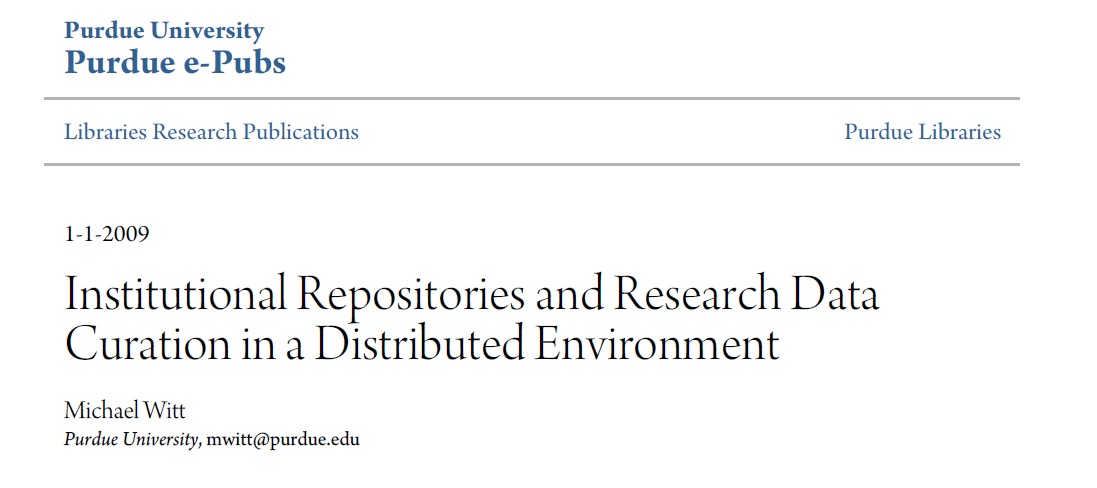
    When I opened it I was simply delighted to find this "Institutional Repositories and Research Data Curation in a Distributed Environment" report by Michael Witt and I was also quite amazed to see its publication date - there are clearly several speeds out there in research data management implementation.


    When trying to figure out how to cite this report I suddenly became aware of the document head: Purdue University, Purdue ePubs, Libraries research Publications, Purdue Libraries. Had this document by any chance been retrieved from an Institutional Repository? So I checked the footnote: "This document has been made available through Purdue e-Pubs, a service of the Purdue University Libraries. Please contact epubs@purdue.edu for additional information". I was simply ecstatic.


    I remember having had this discussion about inserting document covers into repository contents more than once when I worked as IR manager. The arguments for not doing it were always the same: we do have too many documents in the repository by now to start re-processing them all and we should instead focus on getting even more of them filed into the IR. These are quite good arguments indeed, but it's the kind of argument that lead to the issues we're now bitterly complaining about. It's a fact that IRs can be properly managed, that a great improvement in description standards has taken place and that there is a still a long way to go until we reach a consensus on a description standard that can please researchers. But not too many IRs that I know of have implemented this rather simple strategy of providing their documents a cover so that users will be able to identify their source and subsequently give it some credit. Of course there are lots of exceptions to this -if you're in the UK or the US you will say that's something every average repository has already cared for, see for instance this example from Enlighten repository in Glasgow or this other one from the LSE repo in London- but I'd say most IRs, even top-ranked ones, lack this small but very useful feature - since given the joint Open Access repository content figures nowadays, the repository+google/googlescholar combination is pretty much unbeatable. I would even dare to suggest some kind of harmonised international seal for identifying reliable research content coming from an institutional repository from their very cover - so that the user will be able to give credit where credit is due.

    Let me finish this piece of advocacy with a recommendation to read the abovementioned Purdue University Library report to any colleague interested in potential opportunities for starting out research data management initiatives from the University Library.