Showing posts with label events. Show all posts

Sunday, 27 April 2014

JGIC'2014: Discussing Research Information Management in Catalonia


  The third edition of the Workshop on Research Information Management (Jornades de Gestio de la Informacio Cientifica, JGIC'2014) was held at the Institute for Catalan Studies (IEC) in Barcelona last Apr 24-25. The event brought together over 150 attendees from Catalan universities, research centres, funders and policymakers to discuss different areas in research information management such as research data management, research impact and evaluation, global standards for system interoperability and new features under implementation at institutional research information management systems at universities.


Emphasis was made at JGIC'2014 on topics such as the need to find new models and indicators for research assessment, the emerging best practices in research data management at specific universities, the gradual uptake of ORCID through an intensive advocacy campaign at institutional level and the positive impact of international collaborations on the quality of the research performed in Catalonia. The new Futur institutional research portal developed at Polytechnical University of Catalonia (UPC) was presented. Futur, which has been modeled upon the Dutch Narcis initiative, aims to to increase the online visibility and impact of UPC research results, raise the profile of the University’s researchers worldwide, and facilitate access to scientific communication.


Up-to-date information was also delivered at the event on the Catalan Research Portal (PRC) project, which was first presented last year at the previous JGIC edition . PRC is an initiative by the Consortium for University Services in Catalonia (CSUC) for aggregating research information from different Catalan universities by collecting the data from the institutional CRISs. Once a simplified CERIF-compliant datamodel has been defined, PRC is presently working for ensuring the appropriate mechanisms are made available for the various CRISs (none of which is CERIF-compliant at the moment) to provide a common CERIF-XML datastream into the Portal. PRC will thus become a Catalan CRIS with emphasis on people, publications and projects while providing the means at the same time for all institutional CRISs at Catalan universities to become able to export CERIF-compliant datasets.


Friday, 24 May 2013

It takes two to tango: a few post-ORCID Outreach meeting reflections


  After listening to the presentations delivered at the ORCID Outreach meeting held yesterday at St Anne's College in Oxford, the impression remains that this promising initiative resembles a ball game played by publishers (and the like) on one side of the pitch and researchers and institutions on the other one. In order to enjoy a reasonably amusing game, you need the two sides to be sufficiently balanced. But this is not the case for ORCID - or at least it's not the case so far.

The 'publisher side' - for simplicity purposes - features not just publishers, but also large commercial stakeholders such as Thomson Reuters, CRIS vendors and a wide range of third-party companies. This side is delivering an excellent performance so far by solving all the (otherwise not too complicated) technical challenges posed by the use of ORCID for populating submission systems or CRISes. However, the other side is not doing so well at the moment. One could expect an ORCID deluge to arrive from researchers and institutions interested in becoming ORCID members for providing iDs to all their staff. But this is not happening, or at least not as quickly as the other side is progressing. Which leaves us with fully prepared technical systems and no incoming stream of ORCID iDs to test them and prove their benefits to the research community.

It is true that there are over 140,000 registered authors in the ORCID database as of today. How many of those registered themselves and proceeded to populate their publications into their ORCID account it is impossible to know thus far. But after listening to Paul Peters's presentation on the huge advocacy campaign carried out by a 10-strong team at Hindawi HQs, it's easy to see that many ORCIDs out there are the result of the 'publisher side' work too (oh but wait, we may have some approximate stats on the provenance of ORCID accounts based on the highly-correlated number of visits to the ORCID website).


The argument held by patient observers (which one shares to some extent) says the game re-balancing will eventually happen, but institutions need more time to react - and once they start, the contribution from their side will become unstoppable. Institutions need to figure out their business models and their mechanisms for involving their researchers and all their relevant units in the process for creating and populating ORCID accounts.

Other critical observers -the institutions themselves- seem however not to completely share this approach. In their view, ORCID should be made available as a free service to them, since they're the ones expected to do the hard work anyway. A significant number of stakeholders argue that ORCID needn't become an overcomplicated platform aiming to achieve too many goals at the same time, but rather focus on the basic functionality, namely providing a unique identifier for researchers. Then again, it may not be that simple at all: features like researcher affiliation pose a huge challenge themselves that must be dealt with for offering really useful information from the ORCID iDs.

It becomes evident at some point that best practices are badly needed in ORCID implementation at institutional level so that the advantages of having their ORCID iDs institutionally created (and even maintained) can start to be perceived by researchers. So it's just about getting a critical mass of member institutions in different countries that will pioneer the adoption process - and hopefully receive some credit for it from the community, as they are dealing with the issues in a much harder early adopting way than those institutions that will follow suit.


Thursday, 13 September 2012

Steady progress of Open Access at Kenyatta University and beyond


  As shown in the Open Access trend worldmap in the previous post, Kenya may well be the country where a strongest impulse towards Open Access implementation in a coordinated, cross-institutional way is currently under way. A high number of Kenyan universities are taking steps to issue Open Access policies and to set up their institutional repositories. These include Maseno University, which has recently become the first signatory of the Berlin Declaration on Open Access in Kenya, Kenyatta University, which is about to adopt an institutional Open Access policy and is already running its own IR, Moi University, University of Nairobi and JKUAT, which has recently issued a Digital Repository Policy document so well drafted that it may become a source of inspiration for many other institutions in the continent.

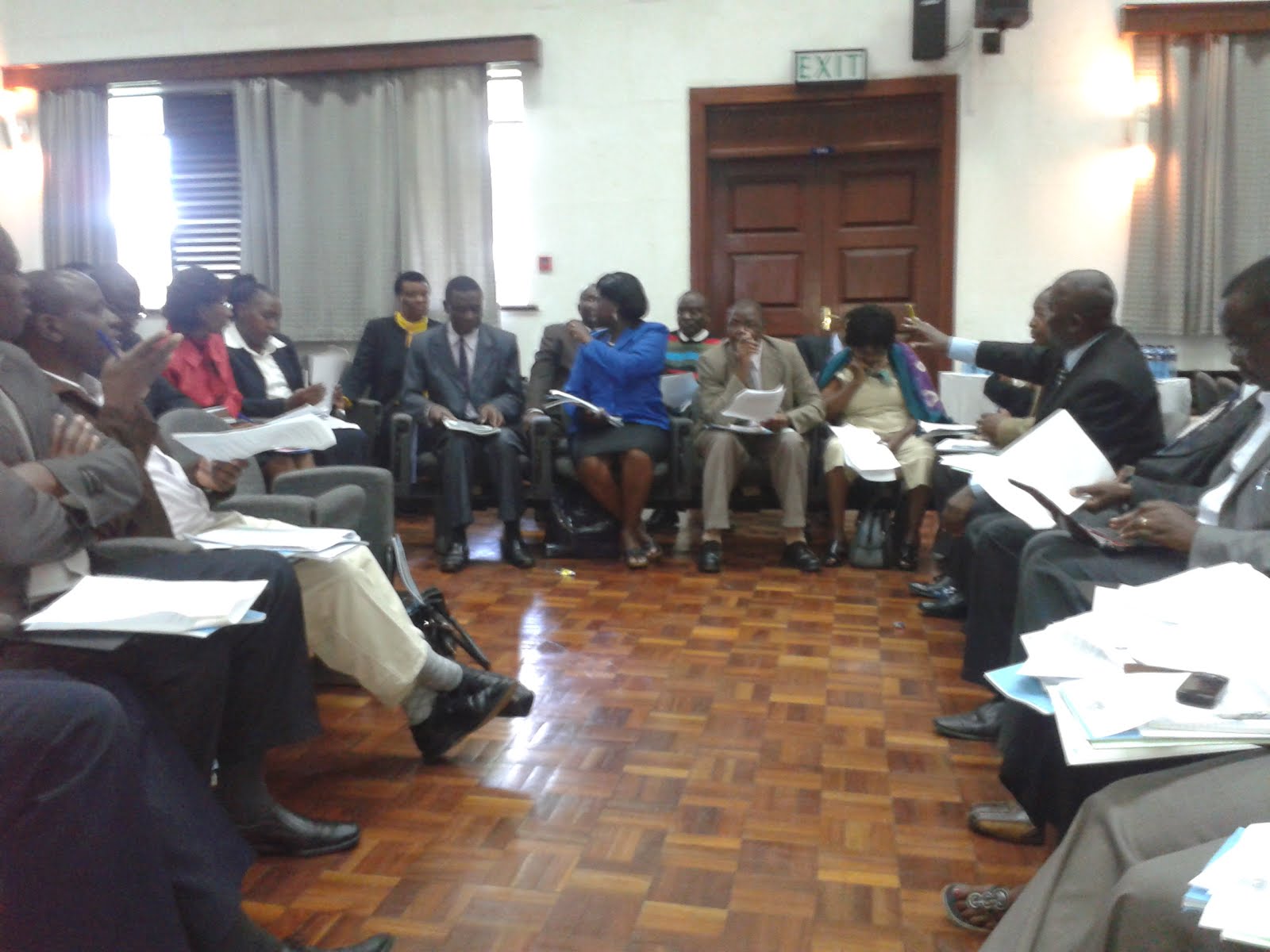
Efforts during the Open Access activity week at KU were aimed to train the Kenyatta University IR and ICT staff and KU researchers and Management Board on Open Access and on how to deal with the new institutional repository which is being developed by the University Library. The 2-day seminar held at the Kenya School of Monetary Studies (KSMS) -organised by Reuben Njuguna, KU Dept. of Business Administration- provided the summit in the OA advocacy sessions held during the week. The first day of this event was devoted to introducing Open Access and its current worklines to the KU Management board, with talks by Gitau George Njoroge, Director of KU Library, Iryna Kuchma, EIFL Open Access Programme manager, William Nixon, Digital Library manager at the University of Glasgow and Brian Hole, manager of the Ubiquity Press Open Access publisher. The second day a round of group discussions was held among the KU VCs and professors in order to establish the guidelines for a draft Open Access policy for KU, which is now under review by the KU Law Department in order to make it final.


In the meantime KU legacy dissertations are starting to be digitised in order to provide full-text files to the metadata-only items that presently constitute the largest part of the KU IR. Metadata sets associated with different document types are also undergoing an update so they'll fit the requirements for providing a thorough description of the KU research output. Once this processes reach an advanced state, an advocacy campaign for further dissemination of the advantages the IR provides the KU community will be carried out at KU Schools. Ideally this should result in KU researchers and professors having the opportunity to offer their online research profiles and publications in the same way as Dr. Erik Nordman, a GVSU researcher in environmental economics who is currently spending a sabbatical year at KU School of Environmental Studies and whose publications are easy to track at his home ScholarWorks@GVSU repository.

The setting up of the KU IR will not only provide visibility for the KU scholarly output, but will also help introducing better description procedures for the Faculty members' publications. Once it gets consolidated as a fully operational reporting tool, the IR will also become the default platform for collecting the KU research output, including the journals internally published by KU Schools and Departments which are currently impossible to track online. If the IR Project at KU is able to keep its cruise speed and meet its strategic goals, the Kenyatta University Library should in the mid-term develop a research information management system as inspirating as its actual building.


With the ongoing EIFL-funded Project “Knowledge without boundaries: Advocacy campaign in Kenya for OA and institutional repositories” providing a solid platform for promoting Open Access and IRs in the country through the Kenyan Library and Information Services Consortium (KLISC), a national network of well-populated institutional repositories could soon become a reality, showing the way ahead to other East African countries.

Friday, 24 August 2012

[Open Access] Spotlight on Nairobi


  Next week a couple of interesting Open Access-related events will take place in Nairobi - making the Open Access spotlight (partly) shift away from Europe, North America and the developed countries into Kenya. It's not the first time interesting Open Access-related events happen in Kenya - a very successful BioMed Central-organised 1st Open Access Africa (OAA) Conference took place in Nairobi in Nov 2010.


Prior to briefly describing these activities, it may be useful for introductory purposes to have a look at this interesting map featured above - courtesy of Benjamin Hennig and his Social and Spatial Inequalities Research Group at the University of Sheffield, UK, based upon data kindly supplied by SPARC. The map shows a ponderated image of the world countries according to the number of Open Access dissemination activities they organised during the Open Access Week event in 2010 (the picture actually remained very much the same for OAW2011). When we look at the current geographical distribution of Open Access repositories worlwide at the OpenDOAR directory, there is a massive bias towards the developed world. However, when we check which countries are doing better in terms of promoting Open Access and establishing their own repository networks, we see both India and Kenya at the top three. In physics terminology, in order to properly describe a situation, you should both account for the actual value and the gradient of such value, gradient meaning its rate of change. So even if values may presently not look too encouraging, they will eventually change as a result of persistent efforts to drive such change.


The abovementioned Open Access activities to be held next week at two Kenyan universities in Nairobi are two good examples for those drivers for change. Kenyatta University will be hosting an Open Access workshop for raising institutional awareness of its Open Access Repository Project. This will be achieved by running different sessions along the 1-week Open Access advocacy seminar for all involved stakeholders within the University: Library and ICT Staff, Researchers from various disciplines and the Kenyatta University Management Board. Also next week, the University of Nairobi will be holding a one day workshop for the University Management Board on Open Access and institutional repositories, paying especial attention to the policy strand. This event is part of the EIFL-funded Project “Knowledge without boundaries: Advocacy campaign in Kenya for OA and institutional repositories”.

Maybe a bit more attention could be paid to Open Access advances in developing countries (even if stakeholders such as BMC and OKFN are already doing it, as well as UNESCO, IFLA and of course EIFL), since it may best serve those countries where severe restrictions to research information apply. Internet connectivity conditions permitting -still a pending issue in most African contries despite recent improvement- there will be some further reporting next week from Nairobi.


Sunday, 17 June 2012

Addendum: la conferencia CRIS2012 y los sistemas CRIS en España


  Desde el punto de vista nacional, la conferencia CRIS2012 arroja algunos resultados positivos: la presencia de representantes de instituciones españolas se ha quintuplicado desde la anterior conferencia CRIS2010 de Aalborg, incluyendo en esta ocasión a la FECYT, así como centros de investigación y universidades en proceso de integración CRIS/repositorio institucional. Entre los avances pendientes, resta aún inaugurar el casillero de presentaciones en conferencias CRIS procedentes de instituciones españolas, estando la aportación nacional restringida por el momento a los euroCRIS membership meetings, donde el año pasado tanto OCU como Sigma realizaron ponencias sobre sus proyectos de desarrollo. Pese a que tanto la duración como el coste de la asistencia a estas conferencias CRIS justifican que no haya habido una presencia mayor este año, algunos de los proyectos presentados en la Jornada GrandIR sobre CRIS y repositorios celebrada el pasado noviembre en Barcelona habría podido perfectamente ser parte del programa de este CRIS2012. Esta situación de infrarrepresentación se equilibrará en todo caso en el próximo euroCRIS membership meeting de otoño a celebrar en Madrid el próximo mes de noviembre, en el que se mostrarán toda una serie de proyectos CRIS de instituciones y organismos en España.

En relación con las cuestiones técnicas debatidas en el programa del evento, cabe mencionar que España como país sigue un camino algo diverso del resto: un proyecto puntero que despierta mucha curiosidad en otros países como el CV Normalizado (CVN) basado en la transferencia de datos desde los CRIS institucionales coexiste con un nivel de implementación de CRIS aún relativamente limitado. Por un lado comienzan a menudear los proyectos de integración CRIS/repositorio para los modelos más consolidados de CRIS (GREC, DRAC, Universitas XXI), y al mismo tiempo la implantación del estándar CERIF en dichos sistemas no ha comenzado aún a producirse en el país.

No es que CERIF sea un estándar imprescindible para el desarrollo de CRIS eficientes -Italia por ejemplo tiene un indice muy elevado de implantación de CRIS institucionales y no están como norma basados en CERIF- pero a efectos de garantizar la interoperabilidad internacional y de incorporar los avances que vienen teniendo lugar en el diseño del modelo de datos de este Common European Research Information Format (incluyendo desarrollos para modelar el impacto social de una investigación o para codificar elementos adicionales de información tales como datos de investigación o research facilities o instalaciones de investigación disponibles), sería muy recomendable contar con al menos algún proyecto de ámbito nacional dedicado al análisis de requisitos para la migración de los modelos de datos actuales a CERIF.

El próximo encuentro de otoño de miembros euroCRIS puede constituir una buena oportunidad para debatir si cabría plantearse una estrategia nacional de implantación de sistemas CRIS institucionales como proveedores normalizados de información sobre producción científica a efectos de su evaluación por parte del Ministerio, de manera similar a como se planifica este proceso en otros países europeos. Funcionalidades añadidas de interés general tales como el estándar ORCID de identificación persistente de autores podrían de hecho integrarse de modo natural en una estrategia de transferencia de información científica de ámbito nacional. Sería interesante en todo caso que alguna universidad o centro de investigación en España reaccionara a la oferta del consorcio ORCID para localizar instituciones interesadas en la implantación temprana de dicho estándar como parte del proceso de consolidación del mismo. En el euroCRIS membership meeting de Madrid habrá asimismo una sesión dedicada al debate sobre identificadores que puede ser el foro ideal para debatir esta materia, dado que se prevé que para el mes de noviembre ORCID se encuentre ya en servicio.

Friday, 15 June 2012

CRIS2012 Conference in Prague: Consolidating CRIS Infrastructure in Europe and the way beyond


  A very successful 11th International Conference on Current Research Information Systems (CRIS2012) was recently held in Prague (June 6-9th, 2012) under the motto “e-Infrastructures for Research and Innovation: Linking Information Systems to Improve Scientific Knowledge Production”. A record 154 representatives from 26 countries attended the most crowded euroCRIS biennial conference ever, and the number of submissions for the conference was also the highest so far (with the UK having the largest number of representatives at CRIS2012 and Norway the best rate of submission acceptance). The usual mix of very different professional profiles (researchers, funders, research managers, research office representatives, institutional repository managers, IT managers, developers...) that makes CRIS conferences so special was even further enriched at CRIS2012 by the large number of colleagues who were attending a CRIS conference for the first time.

This event has indeed meant the maturity milestone for euroCRIS, the European Organisation for International Research Information that holds the CRIS conferences every two years (see report for CRIS2010 conference in Aalborg, Denmark at the SONEX blog). euroCRIS has just turned 10 years old as custodian of the Common European Research Information Format (CERIF) standard and as a key stakeholder in the promotion of CRIS Systems for an efficient Research Information Management in Europe and beyond.

If the UK is known to be the most advanced European country in terms of CERIF-based CRIS implementation in HEIs (see recent report from Rosemary Russell, UKOLN), holding the CRIS2012 conference in an Eastern European contry offered the opportunity to realize how the highest momentum in National CRIS System development in Europe is shifting eastwards, with running or completed projects in Slovakia, Slovenia and the Czech Republic itself *.


Official support to the CRIS2012 conference from the Research, Development and Innovation Council of the Czech Republic was in fact one of the key factors for the event being so successful, including a welcome address by the Czech Prime Minister (and President of the Research Council) at the euroCRIS membership meeting reception at Liechstenstein Palace in Prague. Last but not least, a real key contribution to a successful CRIS2012 was the brilliant event organisation provided by Jan Dvořák (InfoScience Praha s.r.o.) and his team.


One of the main outcomes of the 4-day conference was in fact the announcement of the ongoing development of a DRIS or Directory of Research Information Systems which will collect information on running or in-progress CERIF-based CRIS Systems all around the world along with their features and best practices at their implementation and management. This DRIS should serve starting projects to check out for the best solutions and find institutions they may be interested in contacting for the purpose of developing and implementing their own CRIS. CRIS implementation time is a particularly interesting area, since there are large differences among institutions where CRISs are set up, and best practices and guidelines on institutional data collection could be very useful for those universities starting up with the process.

A brief summary of the talks held along the week-long event should include (at least) three main strands as well as a reference to the evolving CERIF data model, currently at version 1.3 with in-progress work at 1.4 as presented by euroCRIS CERIF Task Group leader Brigitte Jörg. These three main strands are (i) added-value services on CRIS Systems, (ii) CRIS functionality extension to research data management and Linked Open Data and (iii) persistent identifier definition and implementation into the CERIF data model.

1. Added-value services on CRISs
As the number of both national and institutional CERIF-based CRIS steadily grows accross Europe, vendors and institutional IT services team up in order to identify new services the system could provide to researchers and institutions. Some of the proposals for enhanced CRIS interoperability and coverage were presented at CRIS2012, such as the JISC-funded CERIFy project for enabling a two-way CERIF-based data exchange between CRISs and Thomson Reuters InCites service or the 'Next-Generation CRIS' currently being developed at the Karlsruhe Institute of Technology (KIT). This project aims to extend CRIS functionality by providing Social Media features, access via mobile devices and advanced Business Intelligence tools for "making numbers talk" to research managers. Finally, semantics was often mentioned too as a relevant enhancement to CRIS systems at several CRIS2012 presentations.

2. CRIS coverage extension to research data and LOD
Research Data Management (RDM) is one of the areas where CRISs could be most useful to the international research community by enabling a systematic management of institutional research data outputs. In order to do so, the CERIF data model must however be previously extended so it's able to cover research data description and management. The CERIF for Datasets (C4D) Project funded by the JISC MRD Programme and led by the University of Sunderland in the UK is working to CERIFy research data and to enable its subsequent codification into CRISs, using marine sciences datasets and an enhanced version of the MEDIN metadata standard as a basis. Required metadata for data description were also analysed at the "Towards the integration of datasets in the CRIS environment" presentation by Italian IRPPS-CNR, which provided an overview of data archives featured in OpenDOAR that offer information about projects. The ENGAGE Project and its CERIF-based metadata approach for a Public Sector Information data infrastructure were introduced by Nikos Houssos, while CRIS enhancement through Linked Open Data features has been recently acknowledged as a relevant workline by euroCRIS through the creation of a specific LOD Task Group.

3. Persistent identifier implementation into CERIF data model
"The need for identifiers beyond systems is a global requirement but also relevant within organization boundaries spanning multiple systems. Various identifier initiatives and systems have started in the scientific domain and beyond. However, they have not yet achieved the required interoperability".
This quotation from the presentation "Entities and Identities in Research Information Systems" delivered by Brigitte Jörg summarizes the much discussed need to integrate author, organisation and project persistent identifiers into CERIF in order to enable LOD-based approaches to succeed. After a first attempt at UUID-based persistent identifier codification was performed last February at the euroCRIS Task Group meeting in Bath, CRIS2012 featured a specific 'IDs, Disambiguation, Interoperation' session where ID implementation requirements were further discussed.

Recently appointed ORCID Executive Director Laurel L. Haak was attending CRIS2012 and had the chance to describe the road ahead for ORCID implementation along the event. Once ORCID released its API earlier this year, its service will be launched along the 4th Quarter of 2012. Researchers will be able to create, manage and share their ORCID record for free at launch time, and ORCID is currently working with interested universities and research centres for signing agreements for early implementation at institutional level.

An updated presentation of the ORCID initiative -as well as an insight on CERIF enhancement for integrating persistent identifiers- will be featured at the 'Topic session' devoted to Identifiers along the forthcoming Autumn 2012 euroCRIS membership meeting to be held in Madrid next November. A preliminary programme for the event is already available and free registration will soon be opened once CRIS2012 is over.


CRIS2012 Prague closed with an outstanding social programme - including a boat cruise along the Vltava and the chance to attend various events at Museum Night Prague. Before that, IRPPS-CNR in Rome had been announced as the next host to the CRIS conference in 2014 and euroCRIS President Keith Jeffery delivered an inspired closing speech on the future of CRISs, CERIF and Research Information Management.

Links to the slides of all presentations mentioned in this post will be offered as soon as they are made available online.


* as well as northwards, with Sweden also implementing a National CRIS and Norway already operating CRIStin, while in Southern Europe, Italy has already used widely implemented institutional CRISs to collect the national research output earlier this year.