Showing posts with label open access repositories. Show all posts

Friday, 22 March 2013

... and preaching to the non converted


  After quite a long time away from this blog due to various circumstances – with work overload probably being the most convincing one – I will try to catch up with various threads in the next day ot two – and I shall start the attempt with an answer to this request for explaining what Open Access is and what its aims are I was delivered from the interesting comments section of this “Whoops! Are Some Current Open Access Mandates Backfiring on the Intended Beneficiaries?” post by Kent Anderson at The Scholarly Kitchen blog. This is my answer – I tried to keep it as concise as possible, apologies if it may still be a bit long.


I am probably too busy trying to overcome the numerous challenges that stand in the way of Open Access implementation myself to provide a too detailed and accurate description of what Open Access is and what its aims are, but I'll give it a go. Let me start by quoting the Berlin Declaration on Open Access to Knowledge in the Sciences and Humanities (2002):

"The Internet has fundamentally changed the practical and economic realities of distributing scientific knowledge and cultural heritage. For the first time ever, the Internet now offers the chance to constitute a global and interactive representation of human knowledge, including cultural heritage and the guarantee of worldwide access".

According to this, Open Access means ensuring this possibility is realised, and worldwide dissemination of research outputs should indeed be a shared goal for institutions (and its libraries) and for publishers. It means that any researcher anywhere in the world may have the opportunity for the first time in history to freely share her research results (and this includes research data) with the whole research community and beyond. Whether this is achieved through the so-called Gold route (Open Access or hybrid journals) or via Open Access repositories (the Green route) is secondary to some extent - although not of course if business models are our sole concern here.

Open Access deals with the have and the have-nots (which does not just mean developed vs developing countries, but rather privileged vs underprivileged researchers in terms of having or not an institutional coverage for accessing the research information they require for carrying out their own research). And Open Access deals with whether a freely available author's final peer-reviewed manuscript might provide a useful alternative to the much-preferable version of record for those underprivileged researchers who can't or won't afford paying the fees required to read the papers that will allow them keep up-to-date with advances in their own research area.

Research funders are well aware of the challenge, especially those in the area of biomedical research, and Open Access mandates are their attempt to tackle the access issue in an area where many institutions both in rich and poor countries lack the (quite substantial) budgets required to provide their reseachers a comprehensive access to publications in toll-access journals. What about publishers? They are indeed adapting their business models to fit the Gold route by taking Article Processing Charges from authors as a prerequisite to making research papers available Open Access so they can meet the funders' mandates – which is fine. But this adaption to Open Access has not at all improved their image in the eyes of institutions (and many researchers in them), who suspect some not-so-subtle form of double-dipping is taking place since they still need to pay for their journal subscriptions on top of the APCs.

What could publishers then do to stop the fight?

The European PEER Project was a 3-yr STM Publisher Association-lead attempt to assess the impact of Open Access repositories on the 'European Research ecosystem'. This was technically carried out by delivering a large amount of final peer-reviewed author manuscripts into a cross-European institutional Open Access repository network.

Publisher participation ensured the right research article version was deposited, and the whole exercise was also useful for them: not only they were able to become aware of the relevance of sufficient metadata (a concept that CrossRef has later extended among the wider publisher community), but also to harmonise their interoperability standards through the use of the NLM DTD. Furthermore, the conclusions of the PEER project assessment carried out by CIBER Research Ltd was that not only publishers were not harmed by Open Access repositories, but rather on the contrary the paper download figures from journal pages at publisher websites were much improved by their availability as final manuscripts at repositories (since it's the version of record any researcher will prefer to read and cite unless of course they have no means to accessing it).

PEER was a one-time exercise, but it also delivered a proof of concept for cooperation between publishers and institutions in order to provide researchers the service they require for meeting the funders' mandates they are subject to. And in fact some sensible publishers are still interested – and taking subsequent steps in this direction – in delivering their authors the deposit service they require to meet the mandates. The way these sensible publishers see it, this is a means to offer researchers competitive advantages at journal selection time and will ensure a steady number of submissions in an increasingly competitive market framework for journals.

In the meantime the institutional Open Access community (which reached a critical mass quite a long time ago) is taking steps to ensure the repository systems become fit for purpose in order to meet funder requirements in terms of offering OA to the outputs of research projects funded by them. There are indeed technical as well as cultural/political challenges, in fact quite a number of them, but there is also a sustained and persistent effort to figure out the best ways to gradually address them. Institutional Research Committees are suddenly becoming aware (and this is the concern comment #2 addresses) that institutional research publishing budgets won't reach for providing Gold Open Access via payment of APCs for the whole institutional research output, so they're instead turning their eyes to their institutional Open Access repositories and wondering whether it could be the way of meeting funder mandates in a much cheaper fashion. At the same time, some funders are starting to rule hybrid journals out of their mandates for compliance purposes on order to avid the abovementioned risk of double-dipping.

The landscape keeps hastily evolving and it seems further adaption will be required both from publishers and institutions. This could ideally happen through cooperation and not through struggle, but there seem to be too many prejudices and too little efforts out there for a constructive dialogue to take place in a sustainable way.


Thursday, 13 September 2012

Steady progress of Open Access at Kenyatta University and beyond


  As shown in the Open Access trend worldmap in the previous post, Kenya may well be the country where a strongest impulse towards Open Access implementation in a coordinated, cross-institutional way is currently under way. A high number of Kenyan universities are taking steps to issue Open Access policies and to set up their institutional repositories. These include Maseno University, which has recently become the first signatory of the Berlin Declaration on Open Access in Kenya, Kenyatta University, which is about to adopt an institutional Open Access policy and is already running its own IR, Moi University, University of Nairobi and JKUAT, which has recently issued a Digital Repository Policy document so well drafted that it may become a source of inspiration for many other institutions in the continent.

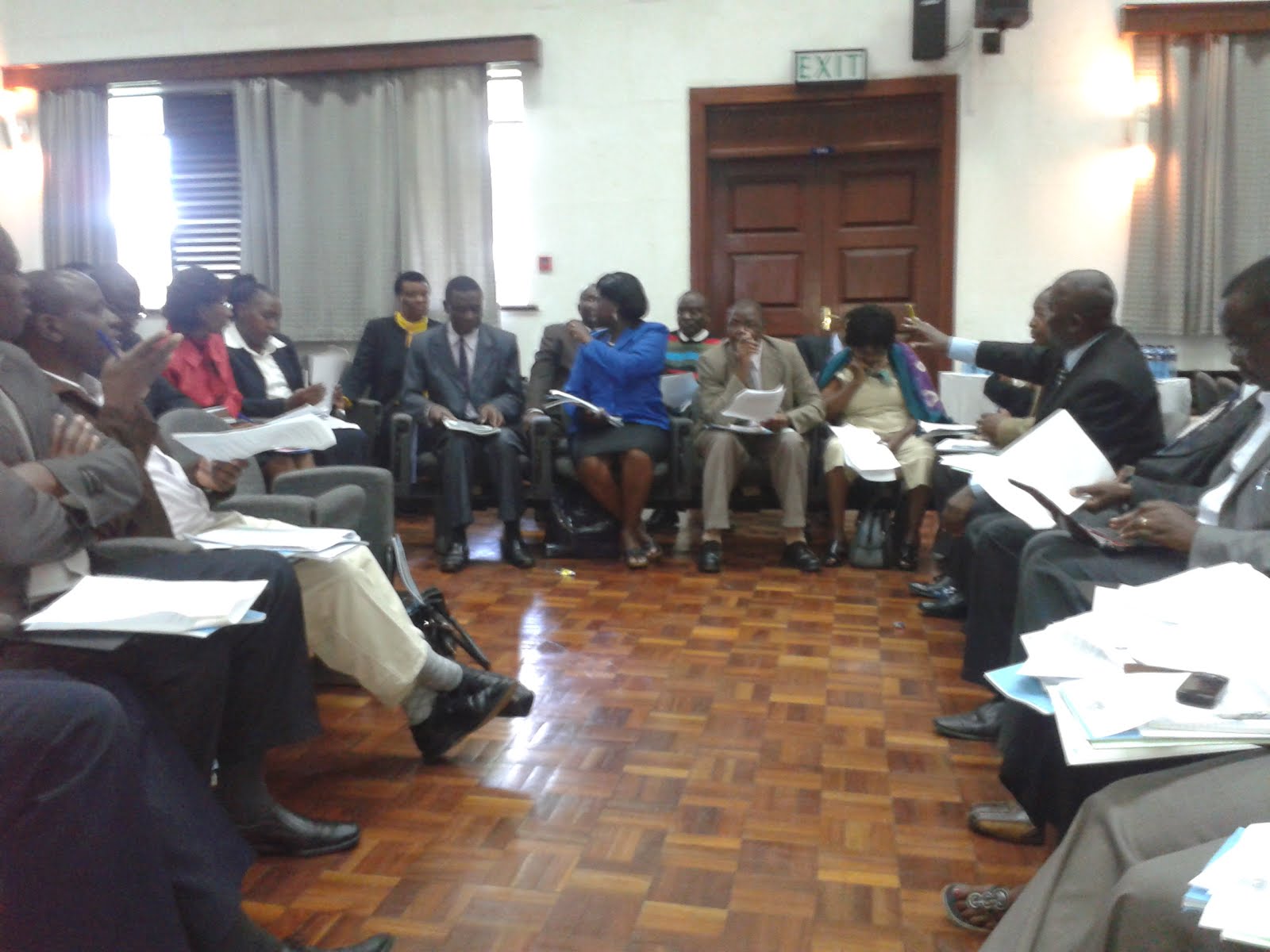
Efforts during the Open Access activity week at KU were aimed to train the Kenyatta University IR and ICT staff and KU researchers and Management Board on Open Access and on how to deal with the new institutional repository which is being developed by the University Library. The 2-day seminar held at the Kenya School of Monetary Studies (KSMS) -organised by Reuben Njuguna, KU Dept. of Business Administration- provided the summit in the OA advocacy sessions held during the week. The first day of this event was devoted to introducing Open Access and its current worklines to the KU Management board, with talks by Gitau George Njoroge, Director of KU Library, Iryna Kuchma, EIFL Open Access Programme manager, William Nixon, Digital Library manager at the University of Glasgow and Brian Hole, manager of the Ubiquity Press Open Access publisher. The second day a round of group discussions was held among the KU VCs and professors in order to establish the guidelines for a draft Open Access policy for KU, which is now under review by the KU Law Department in order to make it final.


In the meantime KU legacy dissertations are starting to be digitised in order to provide full-text files to the metadata-only items that presently constitute the largest part of the KU IR. Metadata sets associated with different document types are also undergoing an update so they'll fit the requirements for providing a thorough description of the KU research output. Once this processes reach an advanced state, an advocacy campaign for further dissemination of the advantages the IR provides the KU community will be carried out at KU Schools. Ideally this should result in KU researchers and professors having the opportunity to offer their online research profiles and publications in the same way as Dr. Erik Nordman, a GVSU researcher in environmental economics who is currently spending a sabbatical year at KU School of Environmental Studies and whose publications are easy to track at his home ScholarWorks@GVSU repository.

The setting up of the KU IR will not only provide visibility for the KU scholarly output, but will also help introducing better description procedures for the Faculty members' publications. Once it gets consolidated as a fully operational reporting tool, the IR will also become the default platform for collecting the KU research output, including the journals internally published by KU Schools and Departments which are currently impossible to track online. If the IR Project at KU is able to keep its cruise speed and meet its strategic goals, the Kenyatta University Library should in the mid-term develop a research information management system as inspirating as its actual building.


With the ongoing EIFL-funded Project “Knowledge without boundaries: Advocacy campaign in Kenya for OA and institutional repositories” providing a solid platform for promoting Open Access and IRs in the country through the Kenyan Library and Information Services Consortium (KLISC), a national network of well-populated institutional repositories could soon become a reality, showing the way ahead to other East African countries.

Friday, 24 August 2012

[Open Access] Spotlight on Nairobi


  Next week a couple of interesting Open Access-related events will take place in Nairobi - making the Open Access spotlight (partly) shift away from Europe, North America and the developed countries into Kenya. It's not the first time interesting Open Access-related events happen in Kenya - a very successful BioMed Central-organised 1st Open Access Africa (OAA) Conference took place in Nairobi in Nov 2010.


Prior to briefly describing these activities, it may be useful for introductory purposes to have a look at this interesting map featured above - courtesy of Benjamin Hennig and his Social and Spatial Inequalities Research Group at the University of Sheffield, UK, based upon data kindly supplied by SPARC. The map shows a ponderated image of the world countries according to the number of Open Access dissemination activities they organised during the Open Access Week event in 2010 (the picture actually remained very much the same for OAW2011). When we look at the current geographical distribution of Open Access repositories worlwide at the OpenDOAR directory, there is a massive bias towards the developed world. However, when we check which countries are doing better in terms of promoting Open Access and establishing their own repository networks, we see both India and Kenya at the top three. In physics terminology, in order to properly describe a situation, you should both account for the actual value and the gradient of such value, gradient meaning its rate of change. So even if values may presently not look too encouraging, they will eventually change as a result of persistent efforts to drive such change.


The abovementioned Open Access activities to be held next week at two Kenyan universities in Nairobi are two good examples for those drivers for change. Kenyatta University will be hosting an Open Access workshop for raising institutional awareness of its Open Access Repository Project. This will be achieved by running different sessions along the 1-week Open Access advocacy seminar for all involved stakeholders within the University: Library and ICT Staff, Researchers from various disciplines and the Kenyatta University Management Board. Also next week, the University of Nairobi will be holding a one day workshop for the University Management Board on Open Access and institutional repositories, paying especial attention to the policy strand. This event is part of the EIFL-funded Project “Knowledge without boundaries: Advocacy campaign in Kenya for OA and institutional repositories”.

Maybe a bit more attention could be paid to Open Access advances in developing countries (even if stakeholders such as BMC and OKFN are already doing it, as well as UNESCO, IFLA and of course EIFL), since it may best serve those countries where severe restrictions to research information apply. Internet connectivity conditions permitting -still a pending issue in most African contries despite recent improvement- there will be some further reporting next week from Nairobi.


Sunday, 5 August 2012

Interesting times for Open Access


  Quite a heated discussion in Open Access circles has followed the recent release of the Finch Report on expanding access to published research findings in the UK and the endorsement by the UK Govenment and funders of its recommendation for making Gold Open Access the default standard for future scientific communication. The day after the UK Government announced it was assuming all but one Finch Report recommendations, the EC also adopted the Communication "Towards better access to scientific information: Boosting the benefits of public investments in research", in which a wider implementation of Open Access -both Gold and Green- to research publications and data was set as a goal for present FP7 and future Horizon2020 European research programmes.

Although usually welcoming its implicit support of Open Access to research outputs, the Finch Report has been heavily criticized within the Open Access movement for not acknowledging the opportunities the available OA repository network and Green OA in general offer to achieve extended access to research publications. The cost of the proposed transition to a Gold OA model was claimed to be disproportionate and most fervid critics dubbed the Finch Report a result of sheer publisher lobbying, while moderate ones pointed out the proposed transition model was unfit for international adoption, especially in developing countries.

However, proposing Gold OA as a default model for extending access to research is hardly a new argument. A couple of months ago at the PEER End-of-Project conference in Brussels -which incidentally had a wide number of publishers in the audience while practically no representatives of repository projects attended the event despite PEER involving both communities- the project managers highlighted one of PEER's main conclusions being that Green OA was not sufficiently popular among research authors and could therefore not be considered the best way for making research outputs widely available. Even if this conclusion may be considered biased and has also been extensively discussed, it is a fact that many researchers from various disciplines do not like open access repositories.

Some of the most conspicuous voices within the Open Access movement do however seem to favour [otherwise perfectly justified] protest against Green OA not being accounted for over self-criticism and analysis of what the reasons are for researchers' frequent preference for open access journals instead of repositories and what steps could be taken in order to overcome such repository shortcomings. Besides criticism of the very expensive alternatives, a clearer lobbying effort would also be desirable for explaining evidence-based advantages of Green OA and the lines the repository community is currently working at in order to improve the user experience. There are very ambitious indeed repository-related projects going on at the moment -such as the UK RepositoryNet+ or OpenAIRE in the EU- aiming to enhance currently existing repository networks so they'll best suit researchers' needs by building upon already large previous experience.

Having had the chance to extensively discuss with researchers what they do and what they don't like about repositories, there seem to be evident issues in the way these platforms have been developed that justify current distrust of them as sound research information sources by a significant numer of authors. Two of the main among these are the lack of metadata harmonisation and the lack of information about work versions filed in the repositories. Although their number is growing and various efforts are under way to improve this, still very few repositories are presently offering harmonised information about funding agencies and projects associated to specific papers or about the version of such papers that is filed in the repository. Other than that, insufficient information is available on the funder policy compliance rates and a significant effort remains to be done in the field of repository usage, where testing repository vs publisher usage for a given work could be quite revealing. All these lines are currently being dealt with by the abovementioned projects, and there will be interesting breakthroughs in coming months around repositories and Green OA.

As for Gold OA, its strong backing by funders and the Government in the UK -as well as implicitly by publishers- opens the door for a gradual transition process (to be mainly but not only tested in the UK as for now) from a subscription-based model to another one relying on Author Processing Charges (APCs), to be increasingly dealt with at institutional level. Two main shortly-arriving outcomes of this transition process should be: (i) new publishing business models for institutional funding of access to research papers -with the RSC 'Gold for Gold' initiative showing the way ahead- and (ii) some standard way of dealing with APCs at institutional level being proposed - with the JISC/Wellcome Trust call for proposals regarding a role in managing payment of Open Access APCs being a first step along that line and initiatives such as Open Access Key (OAK) starting to offer such required services.

These are undoubtedly very interesting times for following Open Access evolution -and the increasing impact of OA-related news in general-purpose media is a good evidence for that- and from a look at the detailed picture of Open Access in the UK recently provided by Nature it's not hard to conclude that Green OA and repositories are here to stay and that the transition process to a Gold OA-based publishing model is set to be a long and winding road.

Tuesday, 22 May 2012

EIFL Workshop on Open Archives in Monastir


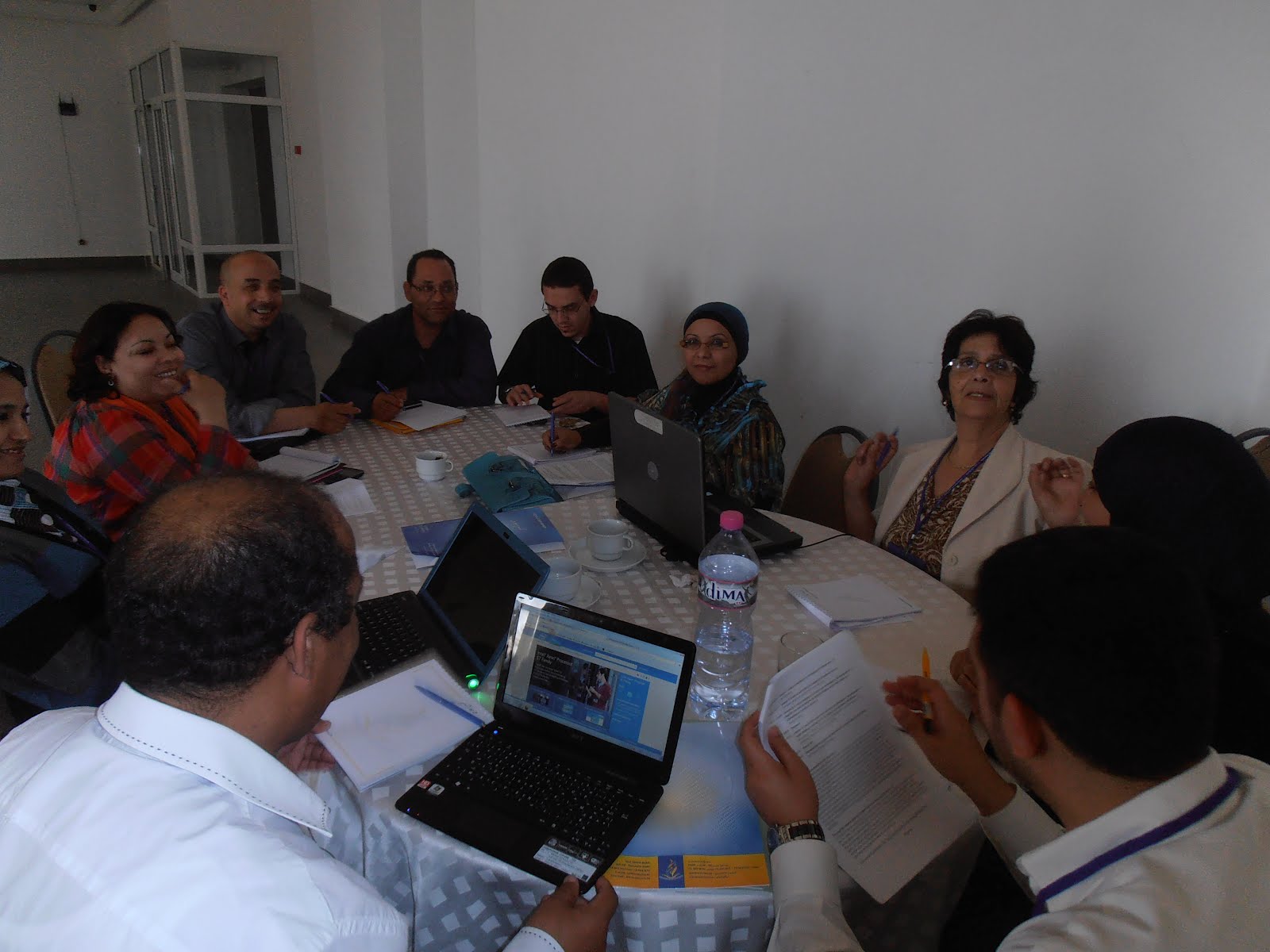
  GrandIR has just taken part in the 'Atélier sur les archives ouvertes' organised last week (May 14-15) in Monastir, Tunisia, by EIFL for promotion and dissemination of Open Access and Open Archives in the Maghreb countries. This workshop was held in the framework of the European Tempus ISTeMag Project for improving access to Scientific and Technical Information in the Maghreb universities. Led by the Université Libre de Bruxelles, this project features twelve universities and research centres in Tunisie, Algeria and Morocco among its partners. As a consequence, the Open Archives workshop in Monastir was well attended by over 30 Maghrebi librarians, developers, research officers, project coordinators and policymakers from all three countries.

Iryna Kuchma, EIFL Open Access Programme Manager, designed a comprehensive programme for the event along with the Tempus project coordinators. The programme covered all aspects of Open Archives, from its benefits to research activity to the obstacles faced for seting them up, from the strategies to develop a repository to copyright, marketing, policies and best practices. In order to provide the expertise, EIFL recruited a few European colleagues who delivered presentations and acted as facilitators for the group debates. Among these experts were Jean-François Lutz, Head of Digital Library at the Université de Lorraine and Pablo de Castro, Director of GrandIR.

There were several group sessions along the 2-day event, in which representatives of various professional profiles from different institutions -and often different countries- engaged in a lively debate and discussed their complementary approaches to specific aspects of Open Access policies, content gathering or marketing activities. Since ISTeMag has already held previous meetings to examine the different aspects of access to scientific and technical information (the most recent one took place last November in Algiers), workgroups discussions were in some sense a follow-up to a more general debate on access.

A Moroccan colleague kindly shared a ranking of universities in the Maghreb countries along the event - featured below. It's interesting to see that there are six Tunisian universities in the top ten, and that three of these top ten-ranked universities are partners in the Tempus ISTeMag Project (two Tunisian, Sfax and Monastir, and one Moroccan one, Marrakesh-Cadi Ayyad). It's also worth mentioning that having an open archive or institutional repository in place will significantly improve the position of a university in these rankings (see also in this regard the Top Africa section in the Web Ranking of World Universities released every six months by the CCHS-CSIC Cybermetrics Lab in Madrid, in which Maghreb universities could probably do better in a global African context).


There are already a few running Open Access repositories in Maghreb countries, with many more in project or in pre-production stages, but there is still a long way to go until the region reaches the level of infrastructure available in other countries in the continent such as Egypt, Ghana or Kenya. The main effort in terms of research output Open Access dissemination is currently being made on theses and dissertations. In fact the three national coordination organisations, the IMIST (Institut marocaine de l'information scientific et technique) in Morocco, the CERIST (Centre de Recherche en Information Scientifique et Technique) in Algeria, and the CNUDST (Centre National Universitaire de Documentation Scientifique et Technique) in Tunisia have already started building their national platforms for dissertations: Toubk@l in Morocco and in-progress platforms for Tunisia and Algeria. This policy of focusing on theses has similarly been aplied at European universities, but then repository managers should keep in mind they're aiming to collect research papers and other high-value institutional research outputs as well, so their visibility will be enhanced as a result. Dissertations being intellectual property of the universities and not always requiring to ask researchers for their permission for offering them online, part of the challenges of Open Access dissemination are rather easily tackled, but then there is no Open Access advocacy carried out and it won't be so easy to extend content gathering to the materials most valued by researchers everywhere.

Efforts like the Tunisian E-doc Université Virtuelle de Tunis (UVT) EPrints-based repository or the Algerian Dépot Numérique de l'Université d'Alger DSpace-based archive are pioneering IR initiatives that are also being mirrored in many other institutions in the Maghreb. As a consequence of the work of this ISTeMag Group on Open Archives, a network of institutional repositories in the Maghreb universities could soon be available.


Friday, 30 March 2012

Raising visibility of repository contents for internet users


  Nowadays it has become commonplace to criticize institutional repositories for their lack of content specificity: you can't tell what version of the document is being made available, there is a lot of materials of insufficient quality in there, everything's mixed up, etc. When one has devoted a good part of one's professional career to develop such useful resources, this criticism is a bit painful to take. It's true IRs have weaknesses, even lots of weaknesses, but there is quite a number of people across the world working to solve them and to improve IR content quality and description. And IRs do have a decent collection of advantages alright - that should also be acknowledged to be fair. I shall now highlight one of those advantages, incidentally not even the most important one.

This morning I was looking for some bibliography on research data management performed via institutional repositories for a report I'm currently working at. So I googled research data management institutional repositories and this is what I got:


The reference that caught my attention was of course the one with the red square around it: seems to be called Institutional Repositories and Research Data and seems to be coming from Purdue University Library in the US, although the exact source is difficult to tell from the URL there: docs.lib.purdue.edu/cgi/viewcontent.cgi?...research.

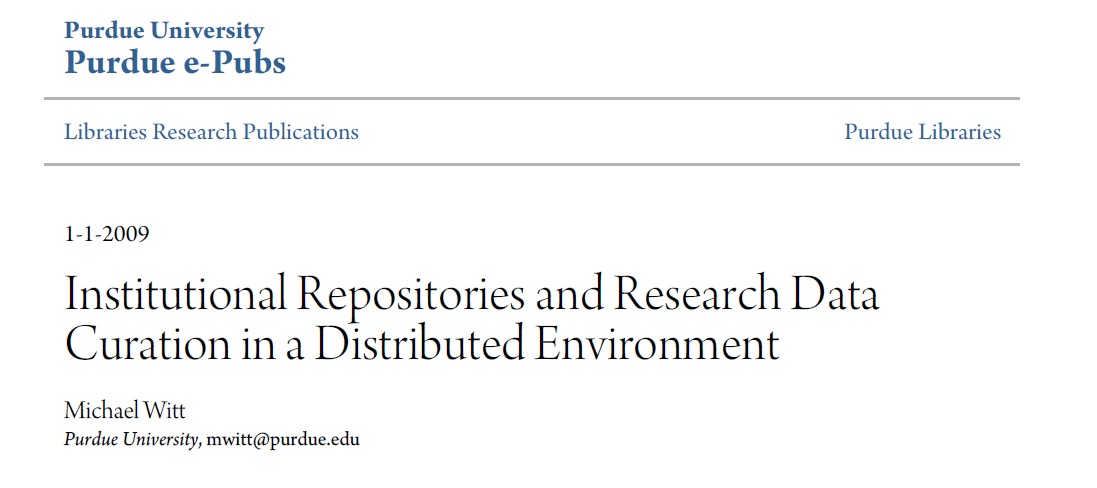
When I opened it I was simply delighted to find this "Institutional Repositories and Research Data Curation in a Distributed Environment" report by Michael Witt and I was also quite amazed to see its publication date - there are clearly several speeds out there in research data management implementation.


When trying to figure out how to cite this report I suddenly became aware of the document head: Purdue University, Purdue ePubs, Libraries research Publications, Purdue Libraries. Had this document by any chance been retrieved from an Institutional Repository? So I checked the footnote: "This document has been made available through Purdue e-Pubs, a service of the Purdue University Libraries. Please contact epubs@purdue.edu for additional information". I was simply ecstatic.


I remember having had this discussion about inserting document covers into repository contents more than once when I worked as IR manager. The arguments for not doing it were always the same: we do have too many documents in the repository by now to start re-processing them all and we should instead focus on getting even more of them filed into the IR. These are quite good arguments indeed, but it's the kind of argument that lead to the issues we're now bitterly complaining about. It's a fact that IRs can be properly managed, that a great improvement in description standards has taken place and that there is a still a long way to go until we reach a consensus on a description standard that can please researchers. But not too many IRs that I know of have implemented this rather simple strategy of providing their documents a cover so that users will be able to identify their source and subsequently give it some credit. Of course there are lots of exceptions to this -if you're in the UK or the US you will say that's something every average repository has already cared for, see for instance this example from Enlighten repository in Glasgow or this other one from the LSE repo in London- but I'd say most IRs, even top-ranked ones, lack this small but very useful feature - since given the joint Open Access repository content figures nowadays, the repository+google/googlescholar combination is pretty much unbeatable. I would even dare to suggest some kind of harmonised international seal for identifying reliable research content coming from an institutional repository from their very cover - so that the user will be able to give credit where credit is due.

Let me finish this piece of advocacy with a recommendation to read the abovementioned Purdue University Library report to any colleague interested in potential opportunities for starting out research data management initiatives from the University Library.

Thursday, 22 March 2012

Alicia López Medina appointed as new COAR Executive Director


  The International Confederation of Open Access Repositories (COAR) was launched last October 2009 in Ghent with the aim of providing the framework for a global repository organisation. After the DRIVER European project succeeded in building up a network of European scientific Open Access repositories, COAR took over the challenge of extending such network to other continents. With an increasing number of members and partners across the world, COAR is gradually and steadily spreading its network through Asia and Latin America, as well as signing cooperation agreements with international organisations such as SPARC or LIBER.


The recently published COAR Newsletter No. 2 (Mar 2012) announced COAR Executive Board decision to appoint Alicia López Medina (Universidad Española de Educación a Distancia, UNED) as the new Executive Director of COAR.

An opportunity showed up recently to talk to Alicia -whom we warmly congratulate for her new position- on her new duties and responsibilities as Head of COAR. A brief summary of the conversation follows:

What are the most relevant COAR short-term goals as of today?

There are several worklines COAR will focus on in upcoming months. We want to keep on spreading the organization member and partner network throughout the world as successfully as we have done so far. Partnerships will allow COAR to engage with other international organisations for extending and enhancing joint coordination activities. Besides that, COAR Working Groups are progressing with their tasks for supporting OA repositories in various ways – with repository interoperability as a particularly relevant objective. Finally, as a truly international organization, we consider the contents COAR produces should be available in the languages of the participanting geographical areas, so we will make a strong effort to ensure that.

The Research Information Management community seems to be increasingly relying on non-profit consortia for its development- with organisations such as COAR, euroCRIS or, more recently, ORCID. A common challenge to these organisations is their sustainability and their ability to find a specific business model that ensures it. How is COAR planning to operate in this regard?

Regarding COAR business model -which I’d rather call sustainable operational model- the COAR Annual Meeting and General Assembly 2012, to be held next May in Uppsala, will extensively deal with this issue. We consider that it should be based on both an enlargement of the membership basis and on signing of agreements with relevant international partners. The output from COAR Working Group activities may play a relevant role as well.

COAR is developing its network in a particularly effective way in Latin America. Why is it that a region where the implementation of an Open Access repository network is a rather recent initiative is engaging so strongly with COAR?

COAR has been making a strong and persistent effort to engage with the dynamic Latin American Open Access repository community. As a result of this effort, a Memorandum of Understanding was signed last May 2011 with RedClara and Colabora regional networks.

There are multiple reasons for this synergy between COAR and the Latin American OA Repository Network - see the interview with my colleague Dr. Norbert Lossau [Chair of COAR Executive Board] at the Dec 2011 edition of the DeCLARA Newsletter [p. 13] for a comprehensive account of them. Among these I’d highlight the RedClara BID-BPR Project 'Regional Strategy and Interoperability and Management Frameworks for a Latin American Federated Scientific Institutional Repository Network' which was recently awarded funding by the Regional Public Goods Fund of the Inter-American Development Bank (IDB), and which currently makes Latin America the most active region in the world in terms of repository network building. This project represents a very good opportunity for applying repository coordination and interoperability guidelines right from the start of the network development. Besides that, I would also like to acknowledge the effort carried out by the Latin American repository community, whose representatives were keen to join forces with COAR for pursuing common objectives.

COAR is currently carrying out its activity through three Working Groups: WG1 Repository content, WG2 Repository interoperability and WG3 Repository and Repository Network support and training. Do you think COAR could become as successful as DRIVER was in implementing common working strategies in these areas?

COAR is actually a DRIVER follow-up initiative, and at the same time a more sustainable organization than DRIVER –a two-phase European Project– ever was. If the DRIVER guidelines were very successful in building up an Open Access scientific repository network in Europe, COAR is aiming to extend that network across the world. COAR objectives do also cover aspects that were not directly addressed by DRIVER, such as repository interoperability.

In this regard, the COAR Interoperability Project, which aims to provide a high-level overview of interoperability of Open Access repositories, identify the major issues and challenges that need to be addressed, stimulate the engagement of the repository community and launch a process that will lead to the establishment of a COAR roadmap for repository interoperability, is presently our main technical workline.

Finally, to answer your question, we’d certainly be very happy indeed if the various COAR initiatives could match DRIVER success and we aim to work hard to achieve that goal.

Monday, 19 March 2012

Creciente adopción de CERIF como estándar de trabajo en la implantación de Sistemas CRIS


  Con fecha 15 de marzo se ha publicado por parte de Rosemary Russell, del Centro UKOLN de la Universidad de Bath, la versión completa del informe "Adopción de CERIF en universidades británicas: una panorámica". Este informe analiza la creciente aplicación del estándar CERIF (Formato Común Europeo de Información Científica, Common European Research Information Format) en las universidades británicas como base para la implantación de sistemas CRIS (Sistemas de Información Científica en Curso, Current Research Information Systems).


El estudio identifica cinco áreas de uso de CERIF (Plataformas CRIS en universidades, Proyectos del Joint Information Systems Committee-JISC, Repositorios institucionales interoperables con sistemas CRIS, Agencias de financiación y Editores internacionales) y encuentra que 51 instituciones en el Reino Unido están trabajando a día de hoy con sistemas CRIS basados en CERIF, lo que corresponde a un 30.7% de adopción de CERIF como estándar.

El informe analiza asimismo el proceso de implantación de sistemas CRIS en las universidades, con las dificultades asociadas a la intervención de múltiples departamentos en el proceso. Otros aspectos examinados son la distribución de la responsabilidad de la gestión del sistema CRIS en diferentes universidades, la percepción de los implementadores sobre CERIF y su trabajo de persuasión sobre diversas instacias académicas para que el sistema CRIS no se limite a ser una herramienta ad-hoc más para dar solución a los retos que plantea el próximo ciclo de evalución de la actividad científica en universidades (REF, Research Excellence Framework) que tendrá lugar en 2014.

Según las previsiones, se realizará una nueva "fotografía" del nivel de implentación de CERIF en las universidades del Reino Unido -en permanente evolución- en el plazo de un año.


Thursday, 15 March 2012

Sobre PEER y awareness-raising


  Publica Ángel Borrego (Departamento de Biblioteconomía y Documentación de la Universitat de Barcelona) en el Blok de BiD un extenso e interesante comentario sobre el informe final "PEER Behavioural Research: Authors and Users vis-à-vis Journals and Repositories". Siguen a continuación algunas consideraciones adicionales al respecto, quizá un tanto extensas para incluirlas como comentario al post:

Además de etiquetar las versiones de los trabajos especificando claramente si se trata de la versión publicada o de alguna clase de versión intermedia -algo que se está haciendo cada vez más sistemáticamente- los repositorios institucionales harían bien en distinguir con claridad su sección científica de la de 'otros materiales académicos' (incluyendo por ejemplo fondos patrimoniales). Esto es algo sobre lo que primero DRIVER y más adelante OpenAIRE han hecho notable hincapié, tratando de identificar repositorios con infraestructura científica para el Espacio Europeo de Investigación. La perspectiva desde las bibliotecas universitarias no suele ser sin embargo tan unánime al respecto, y sería quizá ahí donde habría que comenzar una labor de difusión eficaz de lo que son y pretenden los repositorios institucionales.

Por otro lado, en relación con los conocimientos sobre acceso abierto y repositorios de los autores/investigadores, así como sobre su valoración de los mismos como herramientas de difusión de su producción científica, queda claramente mucho camino aún por andar. No obstante, muchos repositorios han alcanzado ya el suficiente grado de consolidación como para poder presentarse como una sólida infraestructura científica institucional en los congresos científicos, facilitando así su conocimiento por parte de los investigadores (véase por ejemplo este 'Computer applications and quantitative methods in Archaeology 2012' que se celebrará próximamente en Southampton con un notable énfasis en aspectos relacionados con el acceso a las publicaciones, sobre todo en el ámbito de datos de investigación).


Finalmente comentar que además de estos aspectos relacionados con el awareness-rising, el proyecto PEER tiene interesantísimas cuestiones que debatir respecto a la interoperabilidad de repositorios y las oportunidades y los retos técnicos que plantea la transferencia de contenido entre plataformas (en el caso de PEER desde plataformas de editores hacia repositorios). Con COAR y el Grupo SONEX trabajando ya sobre estas cuestiones de interoperabilidad, la Conferencia fin de proyecto de PEER del próximo 29 de mayo en Bruselas puede ser una excelente oportunidad para una nueva entrada sobre PEER, sea en el propio Blok o en algún otro foro.

Wednesday, 14 March 2012

Por qué un Blog de GrandIR


  La comunidad de repositorios de acceso abierto cuenta ya con numerosos medios de transmisión de información relacionada con la disciplina: desde listas de distribución como OS Repositorios y LLAAR hasta blogs específicamente dedicados como el Blog del repositorio RUA de la Universidad de Alicante o el Blok de BiD de la Universitat de Barcelona, pasando por un elevado número de newsletters, tales como el de SPARC o el de Peter Suber. La cantidad de recursos de información es de hecho tan numerosa que se hace difícil en ocasiones encontrar tiempo para estar al día de todas las novedades.

Y sin embargo, hay muchas actividades y convocatorias que permanecen sin cubrir a nivel de comentario o reflexión en el panorama del acceso abierto por falta de ventanas y de rapporteurs. Hay muchos proyectos apasionantes de los que casi nadie ha oído hablar en el ámbito porque se están desarrollando en comunidades concomitantes con la del acceso abierto pero faltan los puentes que las comuniquen. Muchos debates enriquecedores que se quedan sin desarrollar, a menudo por falta de tiempo, pero también porque los medios disponibles no son los más apropiados.

Este Blog de GrandIR nace así con la pretensión de contribuir a difundir reflexiones e iniciativas que puedan favorecer el debate en el seno de la comunidad. Como tal Blog de GrandIR, los contenidos serán mayoritariamente aportados -en cualquier idioma, preferentemente en inglés o castellano- por los integrantes de la spin-off GrandIR, pero el blog estará abierto a comentarios y eventualmente a posts invitados de otros miembros de la comunidad de acceso abierto.

GrandIR: Who we are


  GrandIR startup was founded on Dec 2010 by three collegues from the Carlos III University Library in Madrid, Spain. Their goal was to provide technical services for implementing Research Information Management Solutions (mainly Open Access repositories) to the community of universities and research centres in Spain and beyond. The challenge lies in providing these technical services in an agile way from outside the institutions, playing the role of a reliable technical partner with regard to them - not just for dealing with specific technical issues, but also for doing joint scholarly work and project bids.


As of March 2012, GrandIR are:

Pablo de Castro, BSc in Physics, is Director and co-founder of GrandIR. He previously worked in communication and dissemination tasks for the e-archivo Institutional Repository (IR) team at the Carlos III University Library in Madrid. He also managed the Digital.CSIC project for setting up and developing an IR at the Spanish National Research Council/Consejo Superior de Investigaciones Científicas (CSIC). Since June 2009, he coordinates the JISC-funded SONEX Workgroup for Scholarly Output Notification & EXchange, which performs analysis of interoperability issues with regard to research information systems.

Mariano Navarro, GrandIR co-founder and Technology Manager, is Engineer in Computer Science. He previously worked at the Computer Support Service for the Carlos III University Library and in the Bank Management System sector. He contributes extensive expertise in programming and administration environments, as well as wide skills in the installation, customization and administration of content management platforms. As GrandIR Technnology Manager, he is in charge of providing the required support for specific technical challenges - relying for this purpose on a network of external collaborators when required.

Miguel Almazán, GrandIR co-founder and Webmaster, studies Communication Systems Engineering at UC3M. Having also worked at the Carlos III University Library, he provides a technical and a content-oriented background at the same time. He currently deals with GrandIR website and social network profile maintenance while supplying additional technical expertise on development work.