Tuesday, 26 March 2013

First successful automated ORCID creation at institutional level


  On March 25th a first successful attempt was made at Universidad de Oviedo (UniOvi) for an automated ORCID creation process for institutional authors. A modest first batch with 10 XML UniOvi author files was fed into the production ORCID API and 9 ORCID profiles were successfully created – with the 10th being identified as a potential duplicate and subsequently reported. A brief description of the process that lead to this result is provided below.


The process

Following extensive ORCID outreach activities in the country, Universidad de Oviedo became the first institutional ORCID member in Spain last December. Once the membership was signed, the decision was made for UniOvi Library and its Bibliographic Information Service Manager Maria Luisa Alvarez de Toledo to become responsible for ORCID adoption at UniOvi. Besides relying on the ORCID technical support service -a big thanks to Catalina Oyler here- UniOvi decided to also contact GrandIR for the purpose. GrandIR had organised the ORCID technical session earlier in September and was very much involved into ORCID dissemination and adoption, so it looked like a good opportunity to put this knowledge to use.

The first step towards ORCID adoption at UniOvi was to define a strategy for institutional ORCID creation and implementation into UniOvi research information management systems. The Library keeps a registry for all UniOvi authors, together with their most frequent signatures and identifiers such as ScopusID or ResearcherID - which are often managed from the Library too. The process involved XML UniOvi author file generation so that these could be fed into the ORCID API.

A testing stage followed: a number of mock ORCID profiles were generated on ORCID OAuth Playground testing environment via the command line. These were successful and allowed to test specific XML configuration with regard to character coding and special characters often found in Spanish names. However, the need to operate from the command line made the ORCID generation process quite a slow one, which would suit the purpose of creating ORCIDs for a few authors, but certainly not for all UniOvi scholars. The decision was then made to develop an application that would allow automated ORCID creation for a large number of authors, and GrandIR took on the challenge. A few weeks later, a first prototype was available for live testing on ORCD production environment. These first tests resulted in 10 XML author files fed to the ORCID API and 9 new ORCID profiles created. Most of these new ORCIDs are still pending claim by authors - and in fact the claiming rate by authors is one of the aspects the Library is looking at before planning further internal outreach strategies.


The challenges

A number of challenges have already been tackled along the way to automated ORCID creation. The main one among these is a consequence of UniOvi being the very first institution to carry out most of the procedures, from requesting and using its credentials to learning how to operate the ORCID APIs. The fact that working together with ORCID was occasionally required to define how specific processes should be carried out was sometimes a bit challenging – but certainly fun as well. Finally, the need to rely on a single-point ORCID technical support service (running on a specific time zone) was also one of the consequences of the pioneering role UniOvi took that will presumably be improved in the future.

One of the big challenges that the UniOvi Library faced – and this will probably be quite frequent at other institutions – was the lack of specific internal technical support for the task. However, this issue could be overcome thanks to the support provided both by ORCID and GrandIR – and it should by no means discourage institutions interested in becoming ORCID adopters, since from now on there will be a growing network of supporting colleagues and institutions available to help.

There are two additional strands in which challenges remain before a far-reaching ORCID adoption is achieved at the University. The first one is cultural, and involves engaging authors into the process of claiming, completing and using their ORCIDs. This should very much be based on a best practice definition and dissemination. The other domain where challenges are still to be tackled is the technical area: first, there is a need for a reliable identification of potential duplicates and possibly for merging ORCID profiles created on different author email addresses, and then, the Library would also wish to have privileges for maintaining the newly-created ORCID accounts and be able for instance to claim publications on behalf of the authors. These are areas where current ORCID work is taking place, and new features will be available in the mid-term that will enable this functionality.

The outcome

The main process outcome has so far been a successful (if humble) attempt for automatically creating ORCID profiles for a few UniOvi authors from the Library. However, once the first ORCIDs were created, extending the coverage to the remaining UniOvi authors poses no major technical challenge. Furthermore, the successful identification by the application for automated ORCID generation of a previously existing ORCID for one of these 10 authors was a first step in putting together a set of criteria that will ensure detection of candidates for duplicated entries at ORCID creation time.

The Library has now the opportunity to test the process for ORCID claiming by authors - together with the opportunity to provide useful feedback along the process, for instance by suggesting that it might be useful to allow the welcome message to be customised by the member institution through an option panel that would allow to choose things such as the language the welcome message is written in. Institutional outreach strategies are already being designed, including a brief guide on ORCID claiming for authors and an institutional ORCID website providing an introduction to ORCID and explaining what its benefits are both for authors and the institution itself. All these contents should very much be re-usable by institutions which join ORCID from now on.

The way ahead

The next steps for completing the work are in the first place extending the pilot to cover the whole set of UniOvi scholars. Once this is achieved, strategies are to be designed for implementing the new ORCIDs on institutional systems, starting with the DSpace-based institutional repository RUO. Ideally, ORCID implementation on the repository will provide a means to engage authors with it and ensure that those authors who have not deposited anything yet in the repository will realise some of the value-added services it may provide them.

Finally, a great deal of the remaining tasks fall into the outreach domain: best practices for ORCID use by institutional authors are to be promoted from the Library as part of an awareness raising campaign about ORCID. Besides this, once the process has been completed, the Library has the intention to disseminate best practices in ORCID adoption at institutional level through a somewhat more rigorous channel than a blog post.

Friday, 22 March 2013

Preaching to the converted...


  Sometimes when you try to argue on controversial issues - say for instance you consider that the coverage of sex abuse in the media is biased and lacks objectivity - you'll be accused of not being interested in figting sex abuse. Regardless of how frequently found around the place these days, it's the sort of argumentation that will drive you mad, since its sole purpose seems to be to avoid discussing the issue itself.

Open Access is no exception in this regard. I do not think my personally being pro-Open Access or anti-Open Access should be part of the discussion here, but you may check posts below should this paragraphs raise any doubt about it. Incidentally I happen to be a physicist and have had the opportunity during my extensive Open Access dissemination activities (and have taken great pleasure in it) to discuss it with dozens of researchers from all fields, possibly hundreds of them, many of them Open Access-friendly, some of them reluctant, nearly all of them interested in a sensible dialogue on the future of scholarly communication.

As a result of these experiences, plus again lots of work for implementing OA at institutional and cross-institutional level, there are two relevant points I would like to make in this post:

1) Librarians ('shambrarians' would probably be more accurate) should refrain from going too far in telling researchers how to perform their professional activity. Librarians/shambrarians usually do not know enough about research and scholars can easily perceive that out of a five minute conversation. This is possibly the main reason for the huge divide among both communities - and the one that does actually explain why repositories are nearly empty. Underpopulated repositories is by no means just a 'keystroke issue' I'm afraid (although solving the 'keystroke issue' will help of course). Asking for strong mandates has lately become a mantra from the 'shambrarian' community, but when you listen to researchers' thoughts about this many of them are far from being convinced this is the right way to deal with Open Access implementation.

2) Open Access success is mainly a technology issue and not a policy one (or not to such extent anyway). Ideally the technology and policy strands should work in parallel, but technology can do without policy, whereas the opposite is not true. If you try to sell researchers an Open Access mandate for depositing their papers on the equivalent of a shack in architectural terms, they will very likely laugh in your face (this is the story of the last 20 years Stevan Harnad often talks about). You need to have a solid technical foundation with solid added-value services for talking researchers into Green Open Access. And that is presently far from being a fact. Regrettably far, I feel obliged to add. Not only that, it is kept far from being a possibility by the regular advocates ignoring most about technology and making emphasis on what they do know about: dialectics. I will not mention particular examples here, since it's not the goal of this post to get personal, but if Open Access is to succeed, the debate should clearly become more technical and less political.

No offence meant in any of this, I should warn. I read as much as I can of what gets published on OA, especially blogposts, and there's not too much I like out there I must say. But I do usually keep my opinions to myself since I believe there may be many different ways for OA to succeed - and fights between passionate Green OA supporters and their critical friends is certainly not one of them.

... and preaching to the non converted


  After quite a long time away from this blog due to various circumstances – with work overload probably being the most convincing one – I will try to catch up with various threads in the next day ot two – and I shall start the attempt with an answer to this request for explaining what Open Access is and what its aims are I was delivered from the interesting comments section of this “Whoops! Are Some Current Open Access Mandates Backfiring on the Intended Beneficiaries?” post by Kent Anderson at The Scholarly Kitchen blog. This is my answer – I tried to keep it as concise as possible, apologies if it may still be a bit long.


I am probably too busy trying to overcome the numerous challenges that stand in the way of Open Access implementation myself to provide a too detailed and accurate description of what Open Access is and what its aims are, but I'll give it a go. Let me start by quoting the Berlin Declaration on Open Access to Knowledge in the Sciences and Humanities (2002):

"The Internet has fundamentally changed the practical and economic realities of distributing scientific knowledge and cultural heritage. For the first time ever, the Internet now offers the chance to constitute a global and interactive representation of human knowledge, including cultural heritage and the guarantee of worldwide access".

According to this, Open Access means ensuring this possibility is realised, and worldwide dissemination of research outputs should indeed be a shared goal for institutions (and its libraries) and for publishers. It means that any researcher anywhere in the world may have the opportunity for the first time in history to freely share her research results (and this includes research data) with the whole research community and beyond. Whether this is achieved through the so-called Gold route (Open Access or hybrid journals) or via Open Access repositories (the Green route) is secondary to some extent - although not of course if business models are our sole concern here.

Open Access deals with the have and the have-nots (which does not just mean developed vs developing countries, but rather privileged vs underprivileged researchers in terms of having or not an institutional coverage for accessing the research information they require for carrying out their own research). And Open Access deals with whether a freely available author's final peer-reviewed manuscript might provide a useful alternative to the much-preferable version of record for those underprivileged researchers who can't or won't afford paying the fees required to read the papers that will allow them keep up-to-date with advances in their own research area.

Research funders are well aware of the challenge, especially those in the area of biomedical research, and Open Access mandates are their attempt to tackle the access issue in an area where many institutions both in rich and poor countries lack the (quite substantial) budgets required to provide their reseachers a comprehensive access to publications in toll-access journals. What about publishers? They are indeed adapting their business models to fit the Gold route by taking Article Processing Charges from authors as a prerequisite to making research papers available Open Access so they can meet the funders' mandates – which is fine. But this adaption to Open Access has not at all improved their image in the eyes of institutions (and many researchers in them), who suspect some not-so-subtle form of double-dipping is taking place since they still need to pay for their journal subscriptions on top of the APCs.

What could publishers then do to stop the fight?

The European PEER Project was a 3-yr STM Publisher Association-lead attempt to assess the impact of Open Access repositories on the 'European Research ecosystem'. This was technically carried out by delivering a large amount of final peer-reviewed author manuscripts into a cross-European institutional Open Access repository network.

Publisher participation ensured the right research article version was deposited, and the whole exercise was also useful for them: not only they were able to become aware of the relevance of sufficient metadata (a concept that CrossRef has later extended among the wider publisher community), but also to harmonise their interoperability standards through the use of the NLM DTD. Furthermore, the conclusions of the PEER project assessment carried out by CIBER Research Ltd was that not only publishers were not harmed by Open Access repositories, but rather on the contrary the paper download figures from journal pages at publisher websites were much improved by their availability as final manuscripts at repositories (since it's the version of record any researcher will prefer to read and cite unless of course they have no means to accessing it).

PEER was a one-time exercise, but it also delivered a proof of concept for cooperation between publishers and institutions in order to provide researchers the service they require for meeting the funders' mandates they are subject to. And in fact some sensible publishers are still interested – and taking subsequent steps in this direction – in delivering their authors the deposit service they require to meet the mandates. The way these sensible publishers see it, this is a means to offer researchers competitive advantages at journal selection time and will ensure a steady number of submissions in an increasingly competitive market framework for journals.

In the meantime the institutional Open Access community (which reached a critical mass quite a long time ago) is taking steps to ensure the repository systems become fit for purpose in order to meet funder requirements in terms of offering OA to the outputs of research projects funded by them. There are indeed technical as well as cultural/political challenges, in fact quite a number of them, but there is also a sustained and persistent effort to figure out the best ways to gradually address them. Institutional Research Committees are suddenly becoming aware (and this is the concern comment #2 addresses) that institutional research publishing budgets won't reach for providing Gold Open Access via payment of APCs for the whole institutional research output, so they're instead turning their eyes to their institutional Open Access repositories and wondering whether it could be the way of meeting funder mandates in a much cheaper fashion. At the same time, some funders are starting to rule hybrid journals out of their mandates for compliance purposes on order to avid the abovementioned risk of double-dipping.

The landscape keeps hastily evolving and it seems further adaption will be required both from publishers and institutions. This could ideally happen through cooperation and not through struggle, but there seem to be too many prejudices and too little efforts out there for a constructive dialogue to take place in a sustainable way.


Tuesday, 1 January 2013

ORCID en los países de habla hispana


  Se leía el otro dia en un tweet que ORCID como iniciativa de identificacion de autores beneficiaría sobre todo a las mujeres, en una referencia a la acendrada costumbre en muchos países de que las mujeres cambien de apellido con el matrimonio.

Dado que esta costumbre no está tan arraigada en el mundo hispanohablante, será tal vez por ello que, con la excepción de España, no se encuentra ningún otro país hispanohablante en la lista de los 25 en los que ORCID está arraigando con más fuerza. Teniendo en cuenta que el registro en ORCID es gratuito para los autores y considerando asimismo el elevado número de excelentes comunicadores en el ámbito de la gestión de información científica que pueblan la lista LLAAR sobre Acceso Abierto y Repositorios, esto no deja no obstante de constituir una considerable sorpresa.

En el día en que tradicionalmente se formulan los propósitos de año nuevo, hacer un esfuerzo por incorporar a los países hispanohablantes a próximas ediciones de este listado internacional podría ser una sugerencia interesante...


Por supuesto, la auténtica razón para la ausencia de los países hispanohablantes de este listado no es la que se apunta más arriba, sino la que se deduce de este otro tweet de fecha 28 de diciembre:

"ORCID now has 42,918 researchers registered, a third via manuscript systems or linking with other IDs"


Monday, 24 December 2012

2012: el año de ORCID

0000-0001-6300-1033, ORCID Outreach WG member


  Estas fechas en las que tradicionalmente se echa la vista atrás para recordar los principales acontecimientos del año son también un buen momento para recapitular novedades y examinar tendencias de futuro en el ámbito de la comunicación científica. En este sentido es fácil aventurar que dentro de diez años 2012 será recordado -entre otras cosas- como el año en que entró en servicio la iniciativa Open Researcher and Contributor ID, el identificador ORCID que finalmente facilitaría la solución a los hasta entonces perpetuos problemas de asignación de las publicaciones científicas a sus autores y de desambiguación de los nombres de éstos.

ORCID se lanzó como servicio a mediados de octubre de 2012, después de un sostenido sprint final por parte del reducido equipo de profesionales que está sacando adelante esta iniciativa sin ánimo de lucro. Poco más de dos meses después de su puesta en servicio, más de 30,000 autores del mundo entero han registrado ya de manera gratuita su identificador desde el formulario de registro en el sitio web de ORCID.

Al mismo tiempo que progresa la adopción individual del estándar a través del boca a boca -con las redes sociales y twitter en particular como un poderoso instrumento de difusión- ORCID continúa la consolidación de su plataforma y de los servicios de integración con editores y bases de datos que desde ella se ofrecen (ver figura más abajo). Para garantizar la sostenibilidad de estos desarrollos y de la iniciativa en su conjunto será precisa la generalización de un modelo colaborativo de suscripción institucional que haga recaer la responsabilidad de la sostenibilidad del servicio en las organizaciones que se benefician del mismo, sean universidades, centros de investigación o editores. Este modelo de implicación institucional colectiva en la provisión de un servicio no es ajeno al mundo de la comunicación científica, donde ejemplos como el nuevo modelo de financiación del repositorio arXiv en la Universidad de Cornell o la iniciativa SCOAP3 del CERN para ofrecer acceso abierto a todo un conjunto de revistas científicas en el campo de la física de altas energías demuestran que es una alternativa viable e incluso preferible a modelos de financiación más restringidos por organizaciones o países.


A medida que avanza el desarrollo de nuevos servicios de integración -que irán consolidando a lo largo del próximo año- el gran reto para el éxito de ORCID reside cada vez más en la comunicación del avance en su implantación, de sus ventajas y de sus procesos de trabajo. En un momento en que comienzan a producirse registros institucionales para la adopción temprana del nuevo estándar de identificación, será fundamental dar a conocer los procedimientos y las estrategias de implantación seguidas por las primeras instituciones en integrar ORCID en sus sistemas de gestión de la información científica, de manera que sean reutilizables por las instituciones que se incorporen a la iniciativa de manera más tardía.

El papel de los servicios institucionales de información (bibliotecas o centros de documentación) resultará también crítico para el éxito de ORCID: será tarea suya poner a disposición de los autores la información necesaria para que ellos puedan registrarse gratuitamente y pasar a formar parte de una iniciativa que cobrará cada vez más fuerza con su adopción por parte de editores, agencias de finaciación y bases de datos internacionales.

Cabe destacar como un ejemplo de buenas prácticas en este sentido la iniciativa de Consol García, 0000-0001-8085-0088, y de sus compañeras de la Universitat Politècnica de Catalunya (UPC), para crear una página web dedicada a ORCID -inicialmente en catalán, ahora también en castellano- como parte del sitio web de Bibliotècnica, la Biblioteca Digital UPC. La UPC no se ha registrado por el momento como miembro de ORCID, pero esto no es óbice para que desde su Servicio de Biblioteca se haya percibido como una línea importante de trabajo la comunicación de información sobre el identificador universal de autor para los académicos e investigadores de la institución. Una adecuada difusión de la existencia de esta página a través de los canales de comunicación institucionales y la extensión de este tipo de iniciativa a otras universidades suponen un impulso decisivo para la consolidación de un estándar que goza por lo demás (ver mapa en la figura inferior) de muy buena salud en España a pesar de la delicada situación económica de muchas de sus instituciones de educación superior.


Tuesday, 18 September 2012

Discussing ORCID... and the Gold vs Green controversy


  A new GrandIR technical session was held on Sep 6th at the Open University of Catalonia (Universitat Oberta de Catalunya, UOC) in Barcelona. This new workshop was devoted to Author IDs and ORCID (Open Researcher and Contributor ID) and brought together representatives from the various stakeholders concerned by the launch of the ORCID service, to take place next Oct 15th. The event programme included ORCID themselves (Martin Fenner, Chair of the ORCID Outreach Working Group), National author ID initiatives (Amanda Hill, Names Project UK), funders (Gerry Lawson, Natural Environment Research Council, NERC), National Research Offices (David Arellano, Spanish Foundation for Science and Technology, FECYT) and publishers/vendors (Philip Purnell, Thomson Reuters). Each of the speakers delivered a presentation (files are downloadable from the session programme) and a round table was held afterwards in order to discuss the requirements for an universal author identifier as well as its implications and challenges.

A summary of the session discussions follows:
    • - ORCID service is set to be launched Oct 15th. Martin Fenner provided an up-to-date view of the ORCID interface as it stands right now, although -he mentioned- it keeps evolving every day.
      - ORCID business model is currently being established along the following lines: the service will be free for individual authors/researchers, and there will be a fee for institutions, to be classified as small or large. Charge for small ones will be $4,000 per year. Overlay services will gradually be made available.
      - ORCID will run different strategies for buiding up an author database: (free) individual registration for authors, collective registration for institutions (for a fee), collection & upgrade from other existing author IDs - such as ThomsonReuters ResearcherID, Scopus Author Identifier, arXiv, etc.
      - ORCID duplication may result from overlapping registration strategies - some dissambiguation work should be required to clear those. ORCID won't be providing this service (at least not at launchtime, although possibly later on), so this might be a potential role for National Author ID projects (such as Names, DAI or Lattes) which lie closer to the authors.
      - Two main workflows have been designed so far for promoting ORCID use: (i) Publisher Workflow, meaning publishers will request ORCIDs to authors at manuscript submission time, and (ii) Funder Workflow, by which funders will request ORCIDs to researchers at grant bid submission time. Several publishers are already working to enable ORCID collection, and research funders are happy to be able to work with a non-profit initiative instead of commercial providers.
    • - Institutions running a CRIS system will be better positioned for ORCID implementation, once the required datamodel updates are performed (euroCRIS CERIF TG is currently working on CERIF datamodel enhancement in order to bring persistent identifiers into the system). For those HEIs not running CRIS Systems (for which CERIF is incidentally not a requirement), Institutional Repositories may as well play a key role for ORCID implementation purposes.
      - There are a number of author ID-related services that ORCID will not aim to provide. Among these, organisation IDs, citations, usage or other value-added services. ORCID actually aims to provide a basic feature (namely author identifier plus attached publications) on top of which other stakeholders are expected to build value-added services. ThomsonReuters ResearcherID (as well as other commercial or national author ID services) is therefore not planned to be superseded by ORCID, but they will co-exist instead.
      - One month away from service launch, there are several important factors that remain unclear, such as the service takeup by authors, the project timeschedule or the level of duplication that may result from overlapping registration strategies. Strategies for service dissemination among the research community remain also to be defined to some extent. However, meetings like the one held in Barcelona or the upcoming one at Humboldt-Universität in Berlin will certainly support awareness-raising among the research community.

  • Finally, the meeting in Barcelona also offered the opportunity to discuss with Gerry Lawson, UK Natural Environment Research Council (NERC), whether the RCUK policy for promoting Gold OA as a default option for complying with their Open Access policy turned the Research Council into "traitors" to the Open Access movement. When offered the opportunity to discuss their view, he said the Coucils were by no means opposed to Green OA - only after ten years work, repositories were still not complying the funders' requirements for tracking Open Access outputs and payments.

    Discussions on the default Gold OA direction the UK has taken following the release of the Finch Report should also account for this current reporting shortcomings in Green OA infrastructures. At the same time, requests for turning the RCUK OA Policy a more balanced supporting tool for both Gold and Green OA seem indeed reasonable enough.

    In summary, the session was very useful for disseminating the current state of the ORCID initiative on the verge of its being released and for discussing its implications and challenges for organisations and initiatives potentially involved in its roll out as a service to researchers and the wider community. Some additional session outcomes are starting to surface as requests for further ORCID dissemination at given universities in Spain - more information on this will be provided in due time. The ORCID Service launch meeting in Berlin next October will also provide new insights on the service that will be dutily reported.

    Video recordings of the interventions will shortly be made available at the UOC O2 Institutional Repository. A useful session summary in Spanish has also been published by Elvira Santamaria at the EPI Blog.

    Thursday, 13 September 2012

    Steady progress of Open Access at Kenyatta University and beyond


      As shown in the Open Access trend worldmap in the previous post, Kenya may well be the country where a strongest impulse towards Open Access implementation in a coordinated, cross-institutional way is currently under way. A high number of Kenyan universities are taking steps to issue Open Access policies and to set up their institutional repositories. These include Maseno University, which has recently become the first signatory of the Berlin Declaration on Open Access in Kenya, Kenyatta University, which is about to adopt an institutional Open Access policy and is already running its own IR, Moi University, University of Nairobi and JKUAT, which has recently issued a Digital Repository Policy document so well drafted that it may become a source of inspiration for many other institutions in the continent.

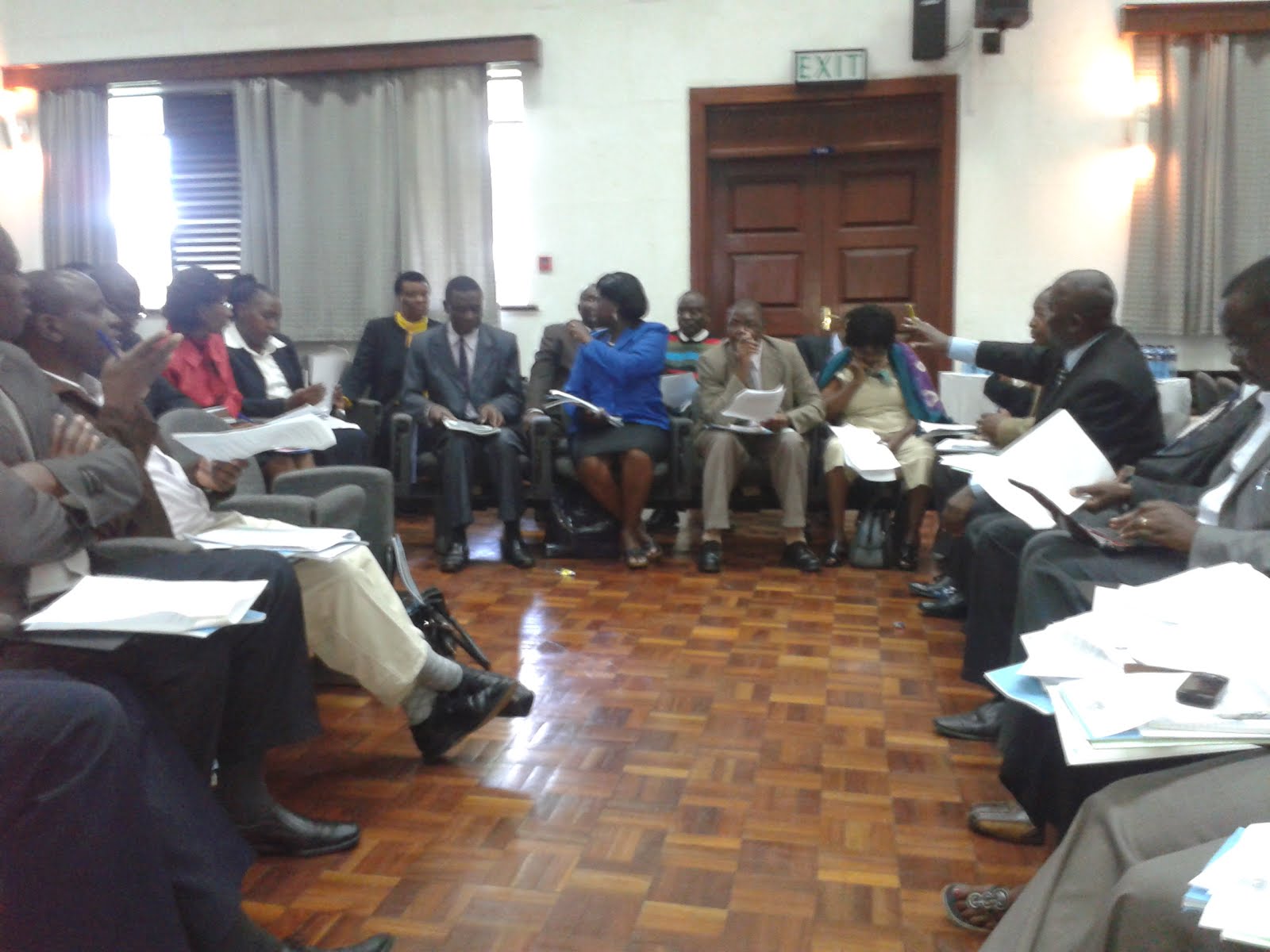
    Efforts during the Open Access activity week at KU were aimed to train the Kenyatta University IR and ICT staff and KU researchers and Management Board on Open Access and on how to deal with the new institutional repository which is being developed by the University Library. The 2-day seminar held at the Kenya School of Monetary Studies (KSMS) -organised by Reuben Njuguna, KU Dept. of Business Administration- provided the summit in the OA advocacy sessions held during the week. The first day of this event was devoted to introducing Open Access and its current worklines to the KU Management board, with talks by Gitau George Njoroge, Director of KU Library, Iryna Kuchma, EIFL Open Access Programme manager, William Nixon, Digital Library manager at the University of Glasgow and Brian Hole, manager of the Ubiquity Press Open Access publisher. The second day a round of group discussions was held among the KU VCs and professors in order to establish the guidelines for a draft Open Access policy for KU, which is now under review by the KU Law Department in order to make it final.


    In the meantime KU legacy dissertations are starting to be digitised in order to provide full-text files to the metadata-only items that presently constitute the largest part of the KU IR. Metadata sets associated with different document types are also undergoing an update so they'll fit the requirements for providing a thorough description of the KU research output. Once this processes reach an advanced state, an advocacy campaign for further dissemination of the advantages the IR provides the KU community will be carried out at KU Schools. Ideally this should result in KU researchers and professors having the opportunity to offer their online research profiles and publications in the same way as Dr. Erik Nordman, a GVSU researcher in environmental economics who is currently spending a sabbatical year at KU School of Environmental Studies and whose publications are easy to track at his home ScholarWorks@GVSU repository.

    The setting up of the KU IR will not only provide visibility for the KU scholarly output, but will also help introducing better description procedures for the Faculty members' publications. Once it gets consolidated as a fully operational reporting tool, the IR will also become the default platform for collecting the KU research output, including the journals internally published by KU Schools and Departments which are currently impossible to track online. If the IR Project at KU is able to keep its cruise speed and meet its strategic goals, the Kenyatta University Library should in the mid-term develop a research information management system as inspirating as its actual building.


    With the ongoing EIFL-funded Project “Knowledge without boundaries: Advocacy campaign in Kenya for OA and institutional repositories” providing a solid platform for promoting Open Access and IRs in the country through the Kenyan Library and Information Services Consortium (KLISC), a national network of well-populated institutional repositories could soon become a reality, showing the way ahead to other East African countries.